Wriai vs Nightwatch: AI SEO Automation vs Rank Tracking Platform
Choosing the right optimization stack requires understanding the fundamental divide between execution engines and monitoring dashboards. When evaluating Wriai vs Nightwatch, you are not simply comparing two software options; you are looking at two entirely different philosophies of search engine optimization. Wriai operates as an autonomous AI SEO automation and content lifecycle management platform built to execute end-to-end workflows from keyword discovery to publishing and indexing. Conversely, while legacy monitoring tools focus purely on position checks—similar to the approach discussed in our guide on Wriai vs Advanced Web Ranking—Nightwatch functions as a specialized SEO rank tracking and AI visibility platform focused on high-precision monitoring across traditional engines and LLM-driven answer interfaces. Understanding how these tools approach organic growth helps digital marketers and enterprise teams build efficient technology stacks.
Core Architectural Differences in Modern Search Platforms
 Wriai vs Nightwatch: AI SEO Automation vs Rank Tracking Platform - Core Architectural Differences in Modern Search Platforms
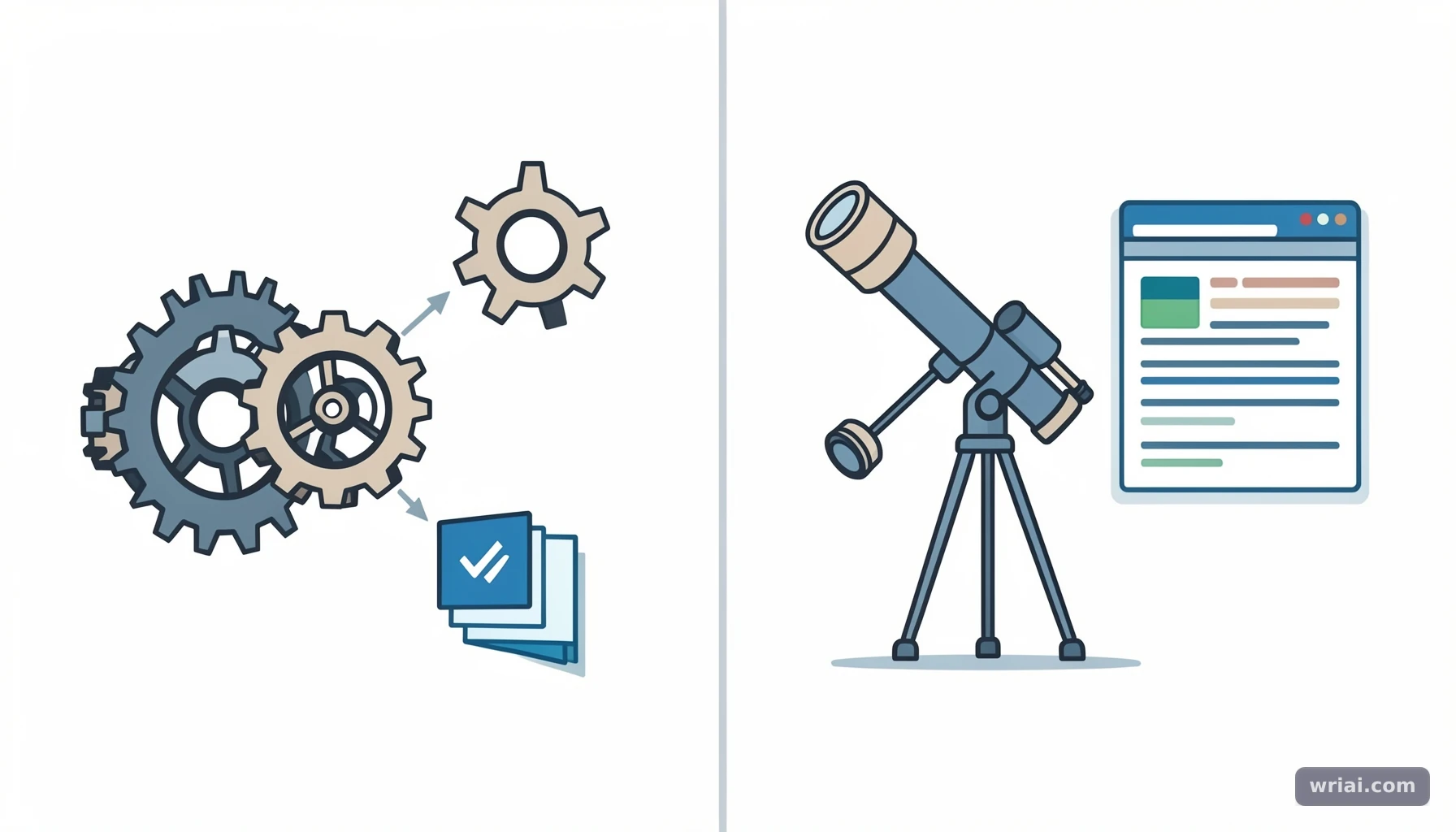
The architectural design of an optimization platform dictates how much manual intervention your team needs to sustain organic visibility. Platforms built for monitoring focus on data aggregation, raw HTML auditing, and rank tracking accuracy. On the other hand, platforms built for execution leverage AI agents to bridge the gap between data discovery and actual content deployment.
Execution vs Monitoring Workflows
Execution-driven systems rely on closed-loop models where data inputs immediately trigger automated tasks. For instance, discovering a keyword gap through market radar tools automatically initiates content creation, AI image generation, internal linking, and CMS publishing. Monitoring systems, by contrast, like those compared in Wriai vs ProRankTracker, capture daily snapshots of search engine results pages (SERPs), tracking position fluctuations across thousands of zip codes and search engines without altering the underlying web pages directly.
Autonomous Agents Versus Data Dashboards
Autonomous architectures use machine learning agents to manage the entire content lifecycle. These agents handle everything from the initial research phase and E-E-A-T content creation to search engine indexing and content decay recovery. Monitoring platforms like Wincher, explored in Wriai vs Wincher, utilize sophisticated data dashboards, visual charts, and API integrations with Google Search Console or Google Analytics to display historical performance trends, leaving the heavy lifting of writing and optimization to human staff or separate external tools.
Integration Ecosystems and CMS Connectivity
The utility of a search platform often depends on how well it connects with your existing web infrastructure. Execution platforms require deep integration with content management systems (CMS) to seamlessly publish articles, update internal links, and distribute content to connected social channels. Monitoring platforms prioritize integration with reporting suites like Looker Studio and white-label client reporting dashboards, empowering agencies to present granular rank tracking data without needing direct editing access to the client website.
Feature Comparison Matrix of SEO Technologies
To evaluate search and visibility tools effectively, comparing their core operational features side by side provides a clear picture of their intended use cases. The table below outlines the distinct technical capabilities, data scopes, and workflow orientations of modern optimization software.
| Feature Category | Wriai Architecture | Nightwatch Architecture |
|---|---|---|
| Primary Core Function | Autonomous content lifecycle management & AI execution | High-precision rank tracking & AI visibility monitoring |
| Workflow Model | Closed-loop execution (Discovery → Creation → Publish → Monitor) | Daily automated checks & performance analytics reporting |
| Geographic Scope | Global search trend and market radar analysis | Granular local tracking across 107,000+ locations & 190+ countries |
| Content Generation | Autonomous E-E-A-T Content Studio & image generation | None (focuses strictly on rank metrics and data integrity) |
| Publishing Capabilities | Automated CMS publishing & multi-channel distribution | White-label client reporting and Looker Studio exports |
| Link Management | Automated contextual internal and external linking | Basic site audit for broken links and missing meta tags |
| Indexation & Maintenance | Direct search engine submission & content decay recovery | Historical SERP tracking and raw HTML storage auditing |
Data Scope and Geographic Granularity
Granular tracking allows digital marketers to measure visibility across hyper-local regions or broad international markets. While traditional tools excel at tracking ranking shifts down to specific zip codes and capturing raw HTML search result audits, autonomous platforms focus on broader market trends, competitor keyword gaps, and semantic content clusters to capture organic search traffic efficiently.
Content Lifecycle and Optimization Depth
Managing content from its initial conception to its eventual refresh requires distinct toolsets. Platforms designed for end-to-end management actively monitor content decay, automatically updating declining pages and generating new semantic assets. Monitoring solutions track how those pages perform over time, alerting your team when rankings drop but requiring external effort to rewrite or restructure the underperforming content.
Visibility Tracking in AI-Driven Search Engines
As search engines evolve to incorporate generative AI answers from models like ChatGPT, Claude, Gemini, and Perplexity, tracking visibility has expanded beyond traditional blue links. Specialized monitoring tools track brand mentions and URL citations inside these generative answers. Meanwhile, automated execution platforms leverage similar LLM intelligence to build authoritative, comprehensive content designed to be cited by both traditional algorithms and generative answer engines.
Practical Implementation and Workflow Integration
Implementing a search optimization platform successfully requires aligning the software's capabilities with your team's day-to-day operational routines. Whether you manage a portfolio of client websites or scale organic growth for a software-as-a-service (SaaS) product, integrating these tools into your existing publishing pipeline dictates your overall efficiency.
Setting Up Automated Content Pipelines
When deploying an execution-focused platform, the initial setup involves connecting your primary CMS, defining your market radar parameters, and configuring your publishing schedules. Once established, the system identifies high-potential keywords through automated opportunity engines, drafts search-optimized articles, generates relevant images, and publishes the finished pieces directly to your site without manual drafting bottlenecks.
Configuring Granular Rank and Citation Monitoring
Deploying a tracking and intelligence tool centers on establishing accurate keyword lists, defining target geographic locations down to specific postal codes, and connecting your Google Search Console properties. SEO professionals configure daily automated checks to audit SERP volatility, track competitor movements, and monitor citation share within LLM-driven search result interfaces.
Managing Agency Reporting and Client Dashboards
For digital agencies, operational workflows revolve around client communication and performance visibility. Monitoring tools simplify this by offering white-label dashboards and seamless Looker Studio integrations, allowing agencies to showcase daily rank improvements, traffic correlations, and local SEO gains. Execution platforms complement agency operations by handling the sheer volume of content production required to scale multi-client campaigns rapidly.
Advanced Strategies, Common Pitfalls, and Best Practices
Maximizing the return on investment from your optimization stack requires adopting proven methodologies while avoiding common operational mistakes. Experienced SEO professionals know that relying solely on automated generation without human oversight or depending entirely on rank data without actionable execution can stall organic growth.
Avoiding Content Bloat and Maintaining Quality
A frequent pitfall when utilizing automated content generation platforms is producing excessive, low-value pages that fail to satisfy search intent. According to strategies emphasized by Alex Vance, sustainable organic growth depends on maintaining strict semantic relevance and ensuring every generated asset provides genuine information gain. Using automated tools to accelerate research and drafting must always be balanced with rigorous quality checks and brand alignment.
Interpreting SERP Volatility Versus Algorithm Updates
Misinterpreting daily rank fluctuations as permanent penalties is a common mistake among site owners. Advanced practitioners use raw HTML audit data and historical tracking to differentiate between temporary SERP turbulence and genuine drops in content relevance. When metrics decline, identifying whether the issue stems from technical site errors, shifting user intent, or content decay ensures you apply the correct remedy—such as fixing broken links or initiating automated content decay recovery.
Combining Intelligence with Autonomous Execution
The most effective modern SEO strategies bridge the gap between intelligence gathering and autonomous execution. By using precision tracking data to identify keyword ranking gaps and feeding those insights into an automated execution workflow, teams create a self-sustaining growth loop. This synergy eliminates the traditional lag between discovering an SEO opportunity and manually publishing the optimized content to capture it.
Choosing the Right Platform for Your SEO Strategy
Selecting between an execution engine and a monitoring dashboard depends heavily on your organization's primary bottleneck. If your team struggles with the sheer operational overhead of keyword research, content creation, internal linking, and publishing, an autonomous platform provides the leverage needed to scale. If your team already has robust content creation workflows but needs absolute precision in tracking local rankings, competitor movements, and AI search citations, a specialized monitoring tool is the ideal fit.
Assessing Team Capacity and Resource Allocation
Evaluating your internal resources clarifies your software requirements. Lean marketing teams and agencies looking to multiply their output often learn how modern ai platforms handle seo optimization alongside automated publishing tasks to reduce manual labor. Conversely, large enterprise teams with dedicated copywriters and editors benefit more from advanced intelligence suites that supply precise analytical data to guide human creators.
Future-Proofing Your Organic Search Stack
As search engines continue to integrate generative AI and semantic knowledge graphs, the line between data analytics and automated execution will continue to blur. Forward-thinking digital marketers are increasingly adopting integrated workflows that combine real-time AI visibility tracking with automated content lifecycle management. Evaluating your current technology stack against these evolving industry standards ensures your organic growth strategy remains competitive in the years ahead.
FAQ
What is the main difference between Wriai and Nightwatch?
Wriai is an autonomous AI SEO automation and content lifecycle management platform designed to execute tasks like keyword discovery, content creation, CMS publishing, and internal linking. Nightwatch is a specialized SEO rank tracking and AI visibility platform focused on high-precision rank monitoring, local tracking across thousands of locations, and tracking citations within LLM-driven search answers.
Can Nightwatch automatically write and publish SEO content for my website?
No, Nightwatch does not generate or publish content. It functions as an intelligence and monitoring tool that provides rank tracking data, site audits, and visibility analytics. To automate content creation and publishing workflows, teams typically rely on dedicated execution platforms built specifically for autonomous content lifecycle management.
How does Wriai handle the search engine optimization workflow?
Wriai operates on a closed-loop model that automates the entire SEO process. It discovers high-potential keywords using a golden opportunity engine, researches and drafts content via an E-E-A-T content studio, generates relevant AI images, publishes directly to your CMS, manages internal links, submits URLs for indexing, and recovers decaying content automatically.
Which platform is better for digital marketing agencies?
Both platforms serve distinct agency needs. Nightwatch is ideal for agencies that require white-label reporting, Looker Studio integrations, and precise local rank tracking across multiple geographic areas. Wriai is better suited for agencies looking to scale their content production and operational output through full-stack SEO automation and autonomous execution agents.
Alex Vance
Head of AI SEO & Autonomous Growth Systems
Specialist with 9+ years of experience in algorithmic search engine optimization, semantic knowledge graphs, and large-scale LLM automation.