Wriai vs AnswerThePublic: AI SEO Agent vs Search Listening Tool
Wriai vs AnswerThePublic is a comparison between two tools built for different stages of SEO. Wriai is designed to automate a broader content lifecycle, from finding opportunities to publishing and monitoring content. AnswerThePublic focuses on search listening: it helps teams explore the questions and comparisons people search for, then use those insights to plan content.
What Each Tool Does—and Why the Difference Matters
The key distinction is execution versus research. One platform is designed to carry SEO work through multiple stages; the other helps reveal what people are asking so a team can decide what to create.
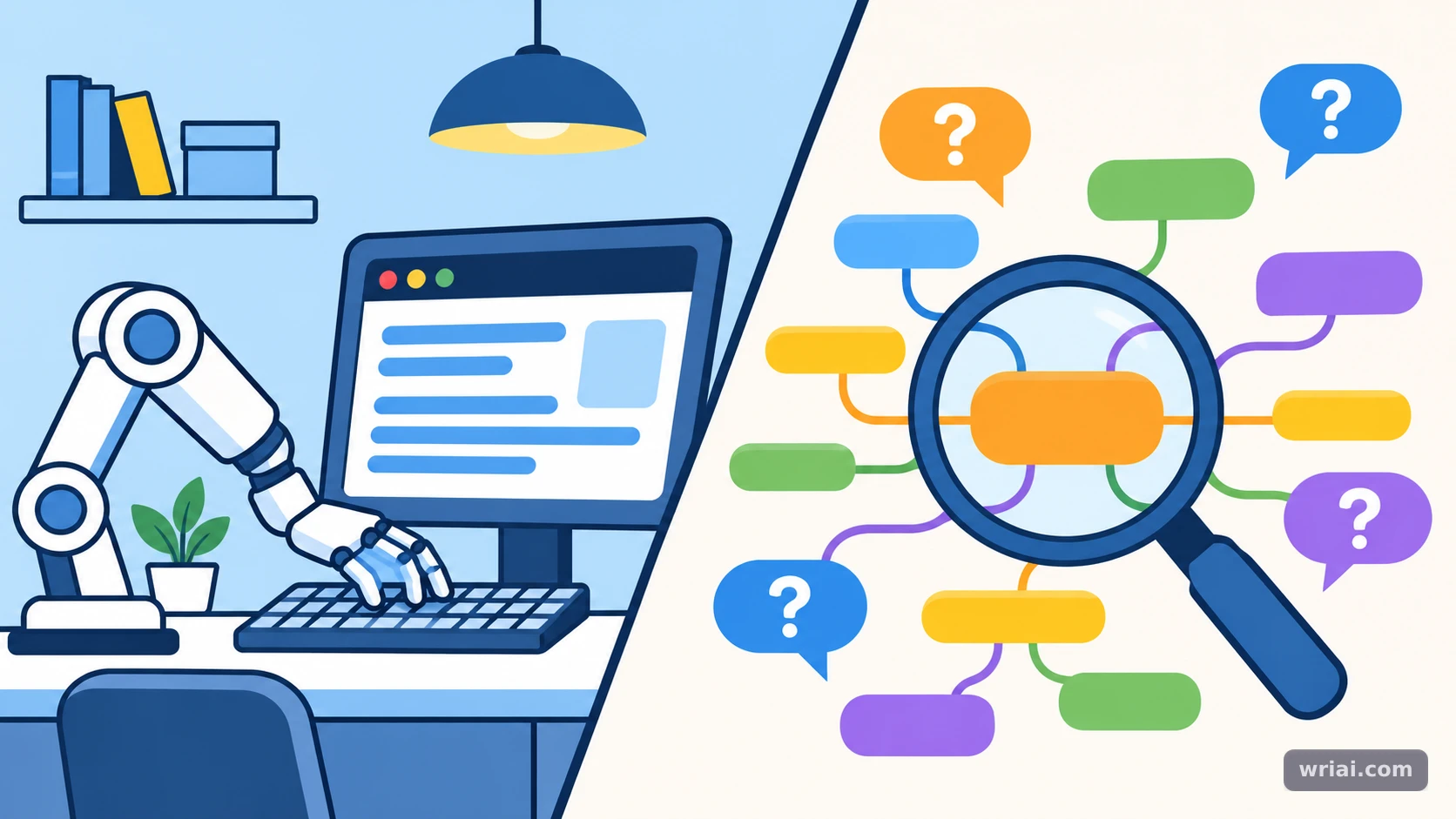 Wriai vs AnswerThePublic: AI SEO Agent vs Search Listening Tool - Visual comparison of automated SEO execution versus search query research
Wriai is built to execute SEO workflows
Wriai is an autonomous SEO automation platform and content lifecycle platform. Its stated workflow connects opportunity identification, research, content creation, publishing, internal linking, indexing, distribution, monitoring, and content recovery. Rather than stopping at recommendations or draft copy, it is designed to have AI agents carry tasks into execution.
Its capabilities include a Golden Opportunity Engine for finding potential keywords and ranking gaps; an E-E-A-T content studio for planning and creating content clusters; automated publishing through CMS integrations such as WordPress and Shopify; linking and indexing tasks; social distribution; and monitoring for content decay. These capabilities make the platform relevant to teams managing a sustained publishing program, especially when several SEO tasks need to happen consistently.
The important distinction is scope, not a promise of a particular ranking result. Automating more steps may reduce manual coordination, but it does not eliminate the need to review claims, verify search intent, maintain editorial standards, and assess whether published pages are useful.
AnswerThePublic reveals search questions and intent
AnswerThePublic is primarily a search listening and keyword research tool, similar in its research focus to the approach examined in Wriai vs Keyword Chef. Given a seed keyword, it organizes related searches into question themes such as who, what, where, why, and how, as well as prepositions and comparisons. That presentation can help a researcher see the range of concerns associated with a topic rather than relying on a single keyword phrase.
For example, a seed term related to project management might surface questions about choosing software, managing remote teams, comparing approaches, or solving a specific workflow problem. Those patterns can inform an article outline, a frequently asked questions section, or a broader content plan. The tool supplies research material; a person or team still decides what deserves coverage and creates, edits, and publishes the resulting content.
AnswerThePublic also offers an AI Dashboard that analyzes how AI models describe keywords. That extends its insight into AI-generated descriptions, but it does not turn the product into a publishing or end-to-end SEO execution system.
Why the distinction matters when choosing
The practical question is where work is getting stuck. If a team has difficulty discovering audience questions and building a focused content brief, search listening may address the immediate need. If the bottleneck is coordinating research, content production, CMS publication, linking, indexing, and refreshes, an execution-oriented platform may be more relevant.
These tools should not be treated as interchangeable simply because both involve AI or SEO. Research output is not the same as an executed SEO workflow, and automation is not a replacement for understanding what readers need. A useful evaluation begins by mapping the actual workflow: which tasks require human judgment, which are repetitive, and where handoffs cause delays or omissions, as explored in this Wriai vs Ahrefs workflow comparison.
How the Tools Compare in Practice
The comparison is clearest when organized by the job each product performs, the stage it supports, and what remains for the user to do. Neither category alone guarantees useful content or improved rankings.
Reference comparison
| Evaluation area | Wriai | AnswerThePublic | Practical implication |
|---|---|---|---|
| Primary purpose | SEO workflow automation and content lifecycle management | Search listening and keyword research | Compare execution needs with research needs |
| Main input or starting point | Website, search, competitor, and opportunity data, as described in its positioning | A seed keyword used to explore related searches | One starts with SEO opportunities; the other with a topic to investigate |
| Typical output | Planned or created content and associated workflow actions | Question, preposition, and comparison themes | Outputs serve different stages and should not be judged by the same metric |
| Content creation | Includes a content studio for planning and creating optimized content | Research insights can inform content ideas and briefs | Research still needs interpretation and editorial production |
| Publishing | Offers CMS publishing integrations, including WordPress and Shopify | Primarily informs research and planning | Publishing remains a separate workflow for AnswerThePublic users |
| Internal linking | Includes smart internal and external linking capabilities | Not its primary stated function | Linking work may need a separate process or tool |
| Indexing and distribution | Includes indexing submissions and social distribution in its workflow | Not its primary stated function | These steps are outside search listening’s core job |
| Performance monitoring | Includes monitoring and content decay recovery | Helps identify audience questions and search themes | Monitoring existing page performance is a different task from discovering query themes |
| AI-related capability | AI agents are positioned to execute SEO tasks | An AI Dashboard analyzes how AI models describe keywords | One emphasizes task execution; the other adds an AI-focused research view |
| Best-fit problem | Keeping multiple SEO execution steps moving at scale | Understanding what people ask about a topic | Choose based on the bottleneck, not on the AI label |
| Human oversight | Needed for editorial quality, factual review, and strategic decisions | Needed to prioritize insights and turn them into useful content | Neither removes the need for informed judgment |
A lifecycle view clarifies the difference
A content program typically has several distinct stages: discover a topic, research it, decide what to publish, create a page, publish it, connect it through internal links, distribute it, monitor performance, and refresh it when needed. Search listening is especially useful near the discovery and planning stages, where query themes help a team understand how readers frame their questions.
An automation platform is relevant across more of that lifecycle when it can support execution steps as well as planning. In the supplied product description, those steps include content creation, CMS publishing, linking, indexing, distribution, monitoring, and decay recovery. That is a broader scope than keyword ideation, but a broader scope does not mean every organization should automate every step.
Teams should compare the actual handoffs they need to improve. For instance, a publisher that already has a strong editorial team but lacks audience insight may get more value from richer research. A publisher with a clear strategy but repetitive operational tasks may benefit more from automation.
How to Use the Tools in a Real SEO Workflow
A practical workflow begins with a reader problem, not a tool feature. Use search-question research to understand the topic, then decide whether the wider SEO process needs automation.
1. Start with a topic and map the questions
Choose a seed keyword that reflects a real audience need. Explore its question, comparison, and preposition themes, then group the results by intent: learning, evaluating options, solving a problem, or taking action. Avoid treating every variation as a separate article. Several phrasings may express the same underlying question and belong in one comprehensive page.
For example, a topic cluster about website indexing might include questions about why a page is not appearing, how indexing works, and what steps a site owner can take. These suggest different reader concerns, but they could fit within one guide if they share a clear purpose. A concise research brief should record the audience, the central question, supporting subtopics, and what the article will help the reader do.
2. Prioritize topics before creating content
Search questions are evidence of interest, not automatic instructions to publish. Review each theme for relevance to the site, whether it can be answered accurately, and whether existing pages already cover it. Then choose the appropriate format: a guide, comparison, tutorial, or a focused update to an existing page.
At this point, separate research findings from editorial decisions. A question may be common but too broad for one article; another may be valuable because it reveals a specific barrier in a buyer’s decision. A prioritization note should explain why the topic matters and how the planned page will add value beyond restating a question. That reasoning helps prevent a content calendar from becoming a list of disconnected keyword variations.
3. Create, review, and publish with clear ownership
Once a topic is approved, create a brief with a direct answer, scope, supporting points, and factual checks. Draft the article, review it for accuracy and usefulness, and make sure it addresses the reader’s actual task. If using an automation platform, define which steps it should execute and which require human approval, especially before publishing.
Wriai’s described workflow can extend from opportunity discovery and content creation through CMS publishing and linking. Its AI SEO workflow guide provides additional context on how SEO optimization and publishing tasks can be connected. Whatever system a team uses, establish a review gate for claims, links, tone, and page purpose. Direct CMS integration can speed publication, but it also makes clear approvals and ownership more important.
4. Monitor pages and decide what to refresh
After publication, track whether the page continues to serve its purpose. A page may need an update because its information is outdated, its coverage misses a reader question, or its performance has declined. Content decay recovery is useful only when the refresh addresses a real problem; changing wording without improving accuracy or usefulness is not a meaningful update.
A disciplined review asks: Is the page still correct? Does it answer the original question? Are important related questions missing? Is the internal linking still appropriate? When a page is underperforming, diagnose before rewriting. This turns monitoring into a decision process rather than a routine of refreshing pages without a clear reason.
Expert Tips, Common Mistakes, and Examples
The best results come from combining audience insight with editorial judgment and operational follow-through. Tool output should guide decisions, not replace them.
Turn question lists into an editorial structure
A list of search questions is a starting point, not a finished outline. Cluster questions by the problem they solve, then decide whether each cluster deserves its own page or belongs as a section in a larger guide. If two questions have different wording but need the same answer, combining them usually makes a stronger resource than publishing near-duplicate pages.
For example, a comparison query and a “which tool should I use?” query may both belong in a decision guide if the reader needs the same criteria to choose. By contrast, a setup tutorial and a product comparison may require separate pages because they serve different tasks. The useful test is whether a reader would expect the same page to resolve both needs.
Avoid common research and automation errors
One mistake is assuming that every surfaced query represents a worthwhile content opportunity. A phrase can be relevant to a topic but still be a poor fit for a site’s audience or expertise. Another mistake is producing pages that repeat keyword variations without adding distinct information. Search listening should improve understanding, not inflate the number of URLs.
Automation introduces a different risk: treating completion as quality. A workflow can create and publish content while still needing human review for factual accuracy, originality, relevance, and appropriate linking. Teams should define ownership for each stage, including who approves drafts and who responds when monitoring identifies a page to review. Automation is most useful when it makes a well-designed process more consistent, not when it conceals an unclear one.
Use the right signal for the job
Suppose a small team knows it wants to publish about a complex software category but has not yet identified the audience’s questions. Search listening can help surface themes for research and an outline. The team can then decide which questions matter, verify its claims, and create a page that answers them clearly.
Now suppose a content team already has approved topics and editorial standards, but staff must manually coordinate drafting, CMS publication, linking, indexing, and ongoing refreshes. An execution-oriented platform may be a better fit for that operational bottleneck. In both cases, judge success by whether the workflow produces useful, accurate pages and maintains them responsibly—not by the number of generated ideas or automated actions alone.
Which Option Fits Your Situation?
Choose according to your current constraint, existing process, and appetite for automation. A research tool and an automation platform can serve complementary roles, but a team does not need both simply because their capabilities differ.
If your main challenge is topic discovery
Prioritize search listening when your team can produce and publish content but needs a clearer picture of the questions people ask. It can help researchers develop topic clusters, shape briefs, and identify comparison angles. It is particularly useful when a seed topic has many possible interpretations and the editorial team needs to distinguish them before drafting.
Plan for the work that follows the research. Someone must decide which questions fit the site, validate the intended audience, create the content, and publish it. If those steps are already handled effectively, a research-first tool may be all the team needs for this part of its process.
If your main challenge is execution at scale
Consider an automation platform when the problem is not a lack of ideas but the number of recurring tasks between an opportunity and a maintained page. A connected workflow can be relevant when teams need help coordinating content planning, creation, CMS publishing, linking, indexing, distribution, monitoring, and recovery.
Before adopting it, map which tasks are safe to automate, where approvals are mandatory, and how the team will check outputs. A small site with an occasional publishing schedule may not need broad lifecycle automation. A larger or more active program may find it useful to reduce repeated coordination, provided its editorial controls remain clear.
If you need both research and execution
Some teams need to understand demand and then reliably carry content through publication and maintenance. In that case, treat research and execution as separate capabilities: use search listening to inform topic choices, then use an appropriate editorial and operational workflow to create and manage the content.
The 2026 AI search landscape makes it tempting to choose tools based on claims about AI alone. A more durable decision is to assess the work each product actually supports. AnswerThePublic’s AI Dashboard adds insight into how AI models describe keywords; Wriai’s stated focus is broader SEO workflow execution. Neither feature, on its own, establishes how a specific page will perform in search or AI-generated answers. Match the tool to a defined job and review the results against your own goals.
FAQ
Is Wriai a replacement for AnswerThePublic?
Not on the basis of their stated primary functions. AnswerThePublic focuses on search listening and keyword research, helping users explore related questions and query themes. Wriai is positioned as an SEO automation and content lifecycle platform that can support tasks such as creation, publishing, linking, indexing, monitoring, and recovery. A team needing audience-question research may prefer the former; a team trying to coordinate SEO execution may evaluate the latter.
Can AnswerThePublic publish articles to a CMS?
AnswerThePublic’s primary stated role is research and search listening, rather than CMS publishing. Its question and comparison themes can inform planning, briefs, and content ideas, but the supplied product information does not describe direct publishing as a core capability. If publication is the main bottleneck, assess the separate tools and processes your team uses to create, review, and publish pages.
Does Wriai find content ideas as well as automate SEO tasks?
Yes. The supplied description includes a Golden Opportunity Engine for identifying potential keywords and ranking gaps, along with an E-E-A-T content studio for planning and creating content clusters. Its stated scope also extends to publishing and other workflow tasks. These capabilities should be evaluated against your own review requirements: identifying an opportunity does not make every topic appropriate, and generated content still needs editorial and factual checks.
Should a team use both tools?
A team may use both if it has distinct needs for search-question research and SEO workflow execution, but combining tools is not necessary by default. First identify the actual gap: topic discovery, content prioritization, production, publishing, or maintenance. Then check whether the current workflow already handles the other stages. Any combination should have clear ownership for research decisions, editorial approvals, publishing, and ongoing performance review.
Alex Vance
Head of AI SEO & Autonomous Growth Systems
Specialist with 9+ years of experience in algorithmic search engine optimization, semantic knowledge graphs, and large-scale LLM automation.