Wriai vs AlsoAsked: AI SEO Automation vs Question Research

Wriai vs AlsoAsked is a comparison between two different kinds of SEO tools: one is built to automate a broader content and optimization workflow, while the other specializes in researching questions from Google’s People Also Ask results. As the Wriai vs Exploding Topics comparison illustrates, the practical choice depends on whether your main bottleneck is executing SEO work at scale or identifying the trends that should shape your content.
What Wriai and AlsoAsked Actually Do
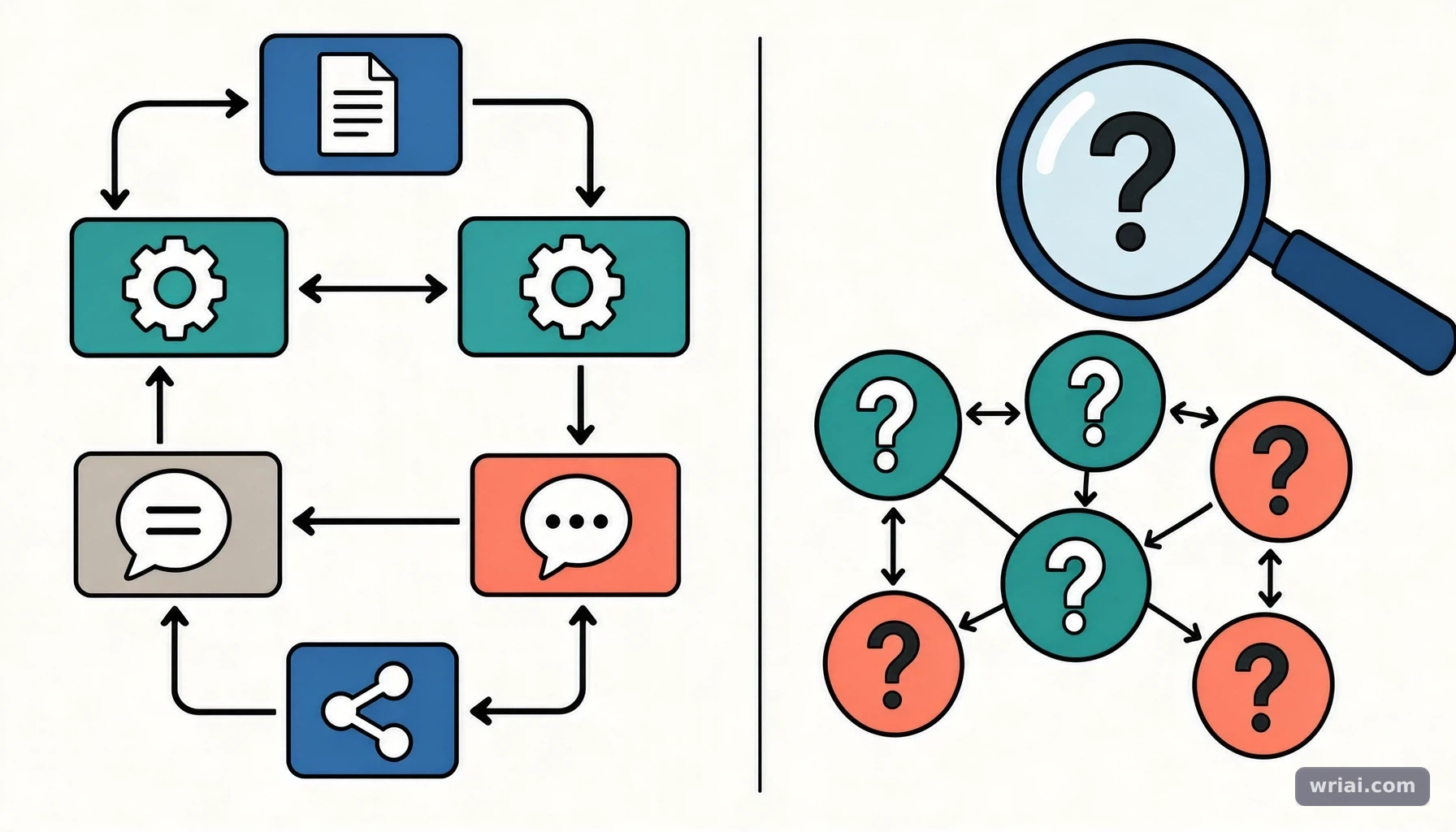
These tools address different stages of SEO. One focuses on coordinating execution across a content lifecycle; the other helps researchers map the questions behind a search topic.
 Wriai vs AlsoAsked: AI SEO Automation vs Question Research - What Wriai and AlsoAsked Actually Do
Wriai: an execution-focused SEO platform
Wriai is designed to run connected SEO workflows, not just provide recommendations or generate article drafts. Its closed-loop process covers opportunity discovery, research, content creation, publishing, linking, indexing, social distribution, performance monitoring, and recovery of declining content.
Its Golden Opportunity Engine identifies potential keywords and ranking gaps using search data. The Autonomous E-E-A-T Content Studio supports research, content optimization, and topic-cluster management, while the AI Market Radar monitors competitor movements and emerging search trends. Other capabilities include AI image generation, automated CMS publishing, contextual internal and external linking, and indexing submissions.
The useful distinction is operational scope. A team looking to coordinate recurring SEO tasks may value a platform that connects discovery, production, distribution, and maintenance. However, automation does not remove the need for editorial review: teams still need to check factual accuracy, audience relevance, brand voice, and whether a proposed update is justified.
AlsoAsked: a question-research tool
AlsoAsked focuses specifically on Google’s People Also Ask data, much like other question-research tools such as AnswerThePublic. It presents related questions in branching visual hierarchies, helping researchers see how a query can lead to follow-up questions and how user intent may develop across a topic.
That makes it a research-layer tool. It can inform content briefs, FAQ sections, and topic clusters, but it does not generate articles or automate publishing. Its distinctive contribution is question discovery, including questions that may not appear in conventional keyword tools such as KWFinder with search-volume estimates.
For example, a team researching “technical SEO audit” might use a question tree to identify follow-up concerns around crawling, indexation, and fixes. Those questions can guide research and page structure. The tree is a source of direction, not proof that every branch deserves a separate page or that every question has meaningful demand.
How Their Capabilities Compare
The comparison is clearest when viewed by task and output. Wriai covers a wider set of execution activities; AlsoAsked provides a narrower, specialized view of search questions.
A practical feature comparison
| SEO task or input | Wriai | AlsoAsked | What the difference means |
|---|---|---|---|
| Main role | SEO automation and content lifecycle management | People Also Ask question research | One coordinates work; the other informs research |
| Core data focus | Website, Google Search Console, competitor, and search data | Google People Also Ask data | Their inputs answer different planning questions |
| Opportunity discovery | Identifies high-potential keywords and ranking gaps | Surfaces question branches related to a query | Use the former to find opportunities; the latter to understand question patterns |
| Topic and intent research | Supports research and content-cluster management | Visualizes related questions and intent paths | AlsoAsked offers a focused view of question relationships |
| Content creation | Supports research, creation, and optimization through its Content Studio | Does not generate content | A question map can inform a brief but is not the finished content |
| Publishing and updates | Automated CMS publishing and updates | No automated publishing | Publishing requires a separate workflow when using AlsoAsked |
| Linking and indexing | Supports contextual linking and indexing submissions | Not part of its stated purpose | These are execution tasks outside question research |
| Distribution and maintenance | Supports social distribution, performance monitoring, and content decay recovery | Not part of its stated purpose | Lifecycle coverage is a key difference |
| Typical output | Opportunities and connected SEO actions across a content lifecycle | A visual map of related search questions | Outputs should be evaluated using different criteria |
| Best fit | Teams seeking to scale and coordinate SEO operations | Researchers building briefs, FAQs, and topic structures | Choose based on the bottleneck you need to solve |
What the comparison does—and does not—show
The table describes product scope, not a guarantee of rankings or content quality. A broader workflow can reduce manual coordination, but it does not make every opportunity valuable or every generated recommendation appropriate. A question tree can reveal useful research paths, but it does not replace source checking, expert input, or editorial judgment.
The tools also should not be treated as direct substitutes simply because both relate to SEO. If your main question is “Which questions should this guide answer?”, AlsoAsked is closely aligned with that task. If the need is “How can we run discovery, production, publishing, linking, and maintenance as a connected process?”, Wriai is more directly aligned.
Neither tool’s stated scope alone establishes that it is sufficient for every part of an SEO program. Teams may need other analytics, editorial, technical, or search tools depending on their existing stack and goals.
How to Use Both in a Practical SEO Workflow
A practical workflow starts with the business and search problem, then uses each tool only where its capabilities fit. Question research can shape the brief; an execution platform can help carry approved work through production and maintenance.
Step 1: Define the page’s job
Before researching questions or automating production, write down the page’s intended reader, purpose, and relationship to existing pages. For example, a software company planning a guide to “customer onboarding” should decide whether the page is educational, product-led, or intended to support an existing product page.
Next, inspect available website and search-performance data to understand what the site already covers and where gaps may exist. Wriai’s stated inputs include website, Google Search Console, competitor, and search data, which can help surface candidate opportunities. Treat those candidates as a shortlist to assess, not as automatic assignments to publish.
This initial framing prevents a common workflow problem: producing content around a keyword without knowing what the page should accomplish or whether the site already has a page serving the same purpose.
Step 2: Map questions into a useful brief
Use AlsoAsked when understanding question relationships is important to the topic. Review the branches and group questions by the reader’s likely task: learning a concept, comparing options, resolving a problem, or taking a next step. Keep questions that add a distinct answer; remove branches that are irrelevant, duplicative, or outside the page’s scope.
Then turn the selected questions into an editorial brief. Specify the page’s main answer, supporting topics, sources to check, and what must be verified by a subject-matter expert. A PAA question is evidence that a question appears in Google’s question feature, not a mandate to include it verbatim or a guarantee of search volume.
For teams planning a larger cluster, question branches can suggest relationships between pages. Validate those relationships against the site’s existing content and audience needs before creating new pages.
Step 3: Create, review, and publish
Once the brief is approved, use the team’s content process to research and draft the page. If the organization uses Wriai’s Content Studio and automated publishing capabilities, those functions can support parts of that process. The brief should still guide human review: confirm factual claims, decide whether the answers are complete, and check that the page offers more than a list of questions.
A publishing workflow should also account for contextual links, distribution, and later performance review. Wriai’s described lifecycle connects these activities, including linking, indexing submissions, social distribution, and monitoring. Its SEO workflow automation overview provides related context on connected optimization and publishing tasks.
After publication, evaluate the page against its purpose and observed performance. Refresh it when evidence indicates the content is declining or no longer serves the reader; do not update it solely because an automated process identifies a possible change.
Expert Tips, Common Mistakes, and Examples
The best results come from matching the tool to the task and applying editorial judgment to its output. Automation and question maps are useful inputs, but neither removes the need to decide what deserves to be published.
Use question branches as evidence, not an outline mandate
A question tree can help expose the path a reader might follow, but turning every branch into a heading can make a page long, repetitive, or unfocused. Instead, ask whether each question changes the reader’s understanding or next action. Combine closely related questions when one clear answer can serve them both; keep a question separate when it requires a genuinely different explanation.
For instance, a guide about choosing a project-management platform might find branches about team size, collaboration, and reporting. These could form a comparison framework if they are relevant to the intended reader. A tangential question about an unrelated workflow may belong elsewhere, even if it appears in the map.
Also distinguish discovery from validation. The presence of a question in PAA can inform research, but the brief should still define the audience, verify any factual claims, and assess whether the proposed page fits the site’s broader coverage.
Keep automation accountable to editorial standards
A platform that connects content creation with publishing can help reduce handoffs, but speed is not the same as quality. Assign clear review criteria before scaling output: source reliability, factual accuracy, distinct value, appropriate internal links, and consistency with the page’s intended purpose.
A useful example is an existing guide whose search performance is declining. A lifecycle workflow may flag it for review; a question-research pass can help identify relevant reader questions to reconsider. The editor should then compare those questions with the page, verify what has changed, and decide whether to revise, consolidate, or leave the content alone.
Common mistakes include publishing every discovered opportunity, treating a question map as keyword-volume data, and assuming that indexing submission guarantees indexing or rankings. Keep a human decision point before publication and before substantive updates, especially when claims affect health, finance, legal matters, or product decisions.
Which Tool Fits Your SEO Situation?
Choose based on the work your team needs to complete, not on which tool has the broader feature list. AlsoAsked is suited to a focused research need; Wriai is suited to coordinating more of the SEO lifecycle.
Choose a question-research tool when…
AlsoAsked is a sensible fit when the immediate task is to understand the questions people ask around a topic, build a more complete brief, or structure an FAQ. It can also help a researcher see how questions branch, rather than treating a topic as a flat keyword list.
It is especially relevant when a team already has a content management and publishing process but needs a dedicated way to explore PAA questions. The output can be handed to a strategist, writer, or subject-matter expert to shape a page.
Do not expect it to execute the rest of the workflow. It does not, according to the supplied product facts, create content, publish updates, manage internal links, or monitor content decay. Those tasks require existing team processes or other tools.
Choose an automation platform—or combine the tools—when…
Wriai is a closer fit when the challenge is coordinating recurring SEO work across opportunity discovery, content, publishing, linking, indexing, distribution, monitoring, and refreshes. This is particularly relevant to teams that need a connected operating process rather than an isolated research output.
The products can also be complementary. A strategist might use AlsoAsked to investigate question patterns, then incorporate selected findings into a brief and pass approved content work into a broader production and publishing workflow. That division preserves the value of specialized research while reducing manual coordination in later stages.
Alex Vance, whose stated experience spans algorithmic SEO, semantic knowledge graphs, and LLM automation, should be understood as the article’s author, not as a substitute for evidence about a particular site. In practice, the right selection depends on your current bottleneck, existing tools, editorial capacity, and ability to review automated work.
FAQ
Is Wriai a direct alternative to AlsoAsked?
Not in the strict sense. They serve different primary purposes: Wriai is designed to automate connected SEO and content-lifecycle work, while AlsoAsked specializes in visualizing questions from Google’s People Also Ask feature. A team seeking question discovery may prefer AlsoAsked; a team seeking broader workflow execution may consider Wriai. Some teams may use both, provided they have a clear process for validating research and reviewing content before publication.
Can AlsoAsked create and publish SEO articles?
No. Based on the supplied product information, AlsoAsked extracts and visualizes People Also Ask questions to support research, content architecture, FAQ planning, and topic clustering. It does not generate articles or automate publishing. Its output is best treated as research input: a writer or strategist must decide which questions matter, verify the answers, and create the content using a separate editorial and publishing process.
Does a People Also Ask question prove that a topic has search volume?
No. A question appearing in People Also Ask indicates that Google has surfaced it in that feature; it does not, on its own, establish a specific search-volume estimate or prove that a separate page is worthwhile. AlsoAsked can surface questions that may not appear in traditional volume tools. Use the questions to explore intent, then assess their relevance, verify the answer, and consider available site and search-performance evidence.
Can an SEO team use both tools in one workflow?
Yes. A team can use AlsoAsked to explore question branches and inform a brief, then use a broader SEO workflow to create, review, publish, link, distribute, and monitor approved content. The handoff should preserve human judgment: select only relevant questions, check factual claims, and review automated updates before they go live. Using both is most useful when question research and lifecycle execution are separate, real needs rather than redundant steps.
Alex Vance
Head of AI SEO & Autonomous Growth Systems
Specialist with 9+ years of experience in algorithmic search engine optimization, semantic knowledge graphs, and large-scale LLM automation.