Wriai vs Mangools: AI SEO Automation vs Traditional SEO Toolkit

Wriai vs Mangools represents the fundamental divide between autonomous AI SEO execution and traditional manual toolkits. Wriai operates as a complete self-driving platform that scans opportunities, generates E-E-A-T content, publishes directly to CMS platforms, indexes pages rapidly, builds contextual links, and monitors performance without constant human intervention. Mangools delivers an intuitive suite of five specialized tools focused on keyword discovery, SERP analysis, rank tracking, backlink auditing, and site profiling that require users to interpret data and implement changes manually, much like other traditional SEO platforms. This expert comparison examines their architectures, workflows, and real-world applications to clarify which system aligns with modern SEO demands in 2026.
Core Definitions and Real-World Architecture
Wriai functions as an autonomous AI SEO platform that executes end-to-end workflows, while Mangools serves as a traditional SEO software suite designed for manual analysis and decision-making by the user. This architectural contrast defines their respective strengths in today's search landscape.
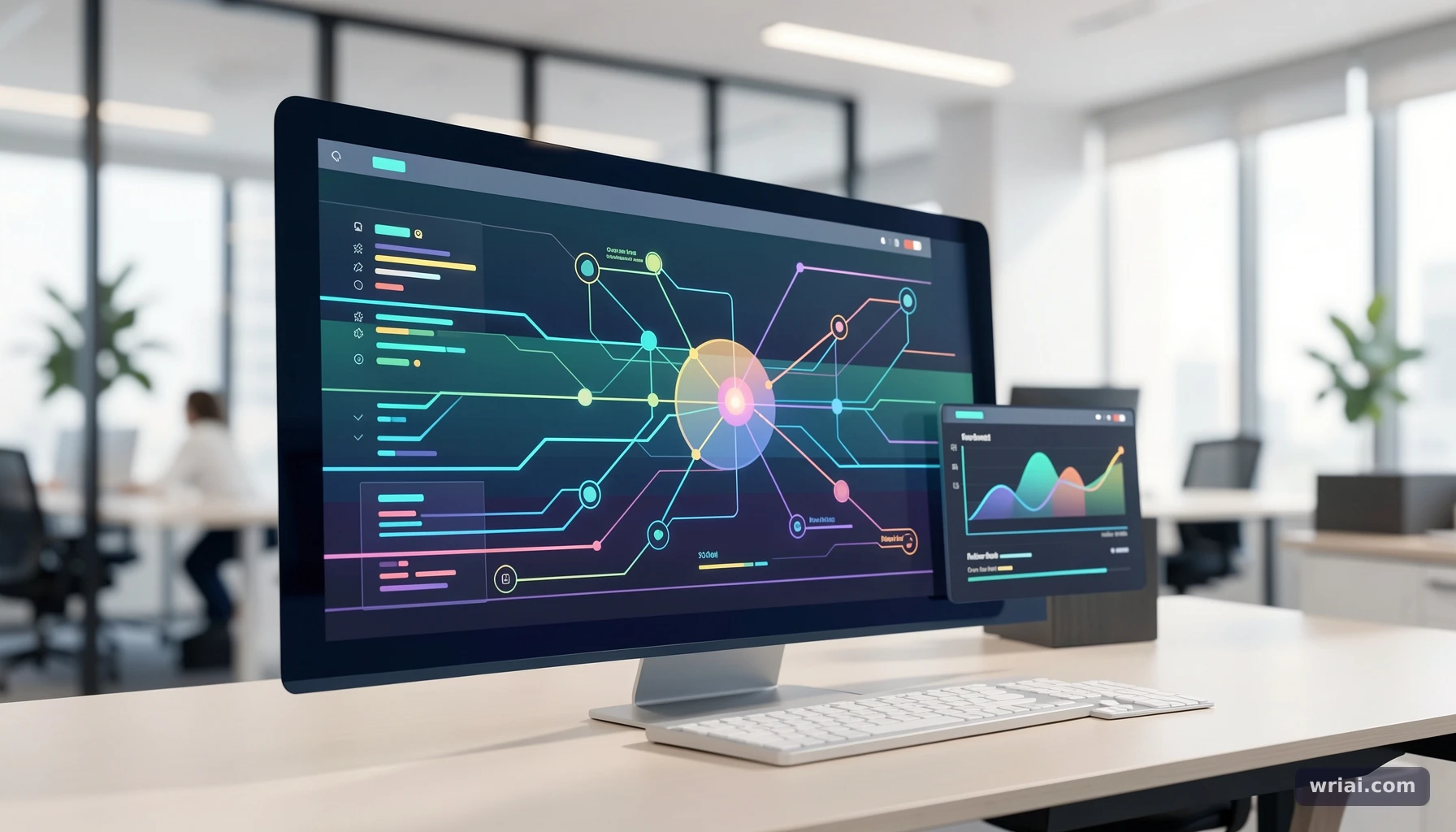 Wriai vs Mangools: AI SEO Automation vs Traditional SEO Toolkit - Core Definitions and Real-World Architecture
Understanding Wriai's Autonomous AI SEO Engine
At its foundation, Wriai employs a closed-loop 10-step pipeline that transforms raw search data into published, optimized, and monitored content assets. The system begins with Google Search Console opportunity scanning to identify ranking gaps with genuine traffic potential. It then activates an E-E-A-T content generator capable of producing comprehensive 2,500-word articles grounded in semantic research and authoritative sources.
The architecture integrates directly with content management systems including WordPress, Shopify, and Ghost for seamless auto-publishing. Rapid indexing occurs through Google Indexing API integration, typically achieving discovery within 24 hours. Contextual internal linking algorithms analyze site architecture to inject bidirectional links that strengthen topical clusters without manual mapping.
Beyond creation, Wriai's system includes a content decay sentinel that continuously monitors performance metrics and triggers AI-powered refreshes when engagement or rankings decline. This creates a true autonomous cycle where opportunity detection, creation, distribution, and optimization occur with minimal oversight. From Alex Vance's perspective at Wriai, this represents the evolution from SEO tools that advise to systems that act, particularly valuable for teams managing multiple properties or large content libraries.
Real-world architecture shines in high-velocity content environments. SEO professionals handling 50+ new articles monthly benefit from the platform's ability to maintain consistency in tone, optimization standards, and internal linking patterns across thousands of pages. The AI Market Radar component scans competitor movements and emerging trends, feeding proactive recommendations directly into the content calendar.
Mangools: A Traditional SEO Software Suite
Mangools takes a different architectural path by consolidating five specialized tools into one clean, accessible interface. KWFinder delivers keyword research against a database exceeding 2.5 billion terms, revealing search volume, difficulty scores, and trend data. SERPChecker provides detailed analysis of search engine results pages across more than 65,000 locations, highlighting competitor weaknesses and featured snippet opportunities.
SERPWatcher focuses on rank tracking for both mobile and desktop results with historical data visualization. LinkMiner enables thorough backlink analysis, while SiteProfiler delivers domain-level insights including authority metrics, organic traffic estimates, and content gap identification. Recent 2026 updates introduced an AI Search Grader that monitors brand visibility across large language models and a Reddit Threads Finder for identifying discussion opportunities.
This architecture prioritizes clarity and usability over automation. The platform excels for freelancers and small business owners who prefer to maintain full control over their SEO strategy. Data flows between tools remain manual—users export keyword lists from KWFinder, analyze SERPs separately, then track progress in SERPWatcher. This deliberate design reduces cognitive overload while providing accurate, transparent metrics that experienced SEOs trust for strategic planning.
The interface emphasizes visual simplicity with color-coded difficulty scores and interactive charts that make complex data immediately actionable. Unlike fully autonomous systems, Mangools stops at insight delivery, requiring the user to execute content creation, publishing, and promotion through separate processes.
Architectural Differences in Approach to SEO Tasks
The core architectural divergence appears in execution philosophy. Wriai's system operates with interconnected AI agents that pass data seamlessly between workflow stages, creating compounding efficiency. For instance, keywords discovered in the Golden Opportunity Engine feed directly into the content generator, which then informs the internal linking module and social distribution engine.
Mangools architecture follows a modular but disconnected design. Each tool functions excellently in isolation but depends on user intelligence to connect insights across modules. This approach offers greater transparency—every metric can be independently verified—but demands significantly more time and expertise to translate data into published outcomes.
In practice, these differences manifest in scalability. Autonomous architectures like Wriai handle exponential content growth effectively because human involvement remains supervisory rather than operational. Traditional toolkits like Mangools scale according to team capacity since every new article requires dedicated research, writing, optimization, and promotion time.
By 2026, industry benchmarks indicate that organizations adopting autonomous architectures report 3.2 times faster content deployment cycles compared to those relying exclusively on traditional toolkits. The architectural choice ultimately determines whether SEO becomes a proactive growth engine or remains a reactive maintenance function. Understanding these foundational differences helps teams align their technology stack with their operational maturity and growth objectives.
Technical Specifications and Workflow Mechanics
Wriai and Mangools differ substantially in technical specifications, with Wriai emphasizing autonomous workflow execution and Mangools focusing on precise data delivery for manual application. The following comparison details their core mechanics across critical SEO processes.
Core Tool Capabilities and Integration Depth
Technical capabilities reveal Wriai's strength in connected systems versus Mangools' excellence in specialized analysis. Wriai's Golden Opportunity Engine combines GSC data, competitor analysis, and semantic gap identification into prioritized task lists that feed subsequent automated stages. Its E-E-A-T content generator employs advanced research protocols that synthesize information from multiple authoritative sources while maintaining natural readability.
Integration depth represents another key specification. Wriai connects bidirectionally with major CMS platforms, enabling true zero-click publishing after content approval. The system also interfaces with social APIs for automated distribution across multiple networks and maintains persistent connections to indexing services for accelerated discovery.
Mangools specifications center on data accuracy and interface responsiveness. Its keyword database updates continuously, providing real-time difficulty calculations based on current SERP features. The SERPChecker processes location-specific data at scale, while LinkMiner employs sophisticated pattern recognition to classify link quality beyond basic metrics.
Workflow Comparison Table
| Workflow Stage | Wriai Implementation | Mangools Support | Automation Level | Primary Output |
|---|---|---|---|---|
| Opportunity Discovery | Autonomous GSC mining combined with competitor gap analysis and trend detection | Manual keyword research via KWFinder with SERPChecker validation | Fully autonomous in Wriai; user-driven in Mangools | Prioritized content briefs (Wriai); keyword lists with metrics (Mangools) |
| Content Research & Creation | AI-driven E-E-A-T generator producing 2,500+ word articles with semantic optimization | Data export for manual content creation using external writers or tools | Complete end-to-end generation | Published SEO articles (Wriai); Research reports (Mangools) |
| On-Page Optimization | Automated during generation with contextual internal linking injected bidirectionally | Manual optimization using exported data and SiteProfiler insights | High autonomy with user approval gates | Optimized live pages with internal links |
| Publishing & Distribution | Direct CMS integration with automated social repurposing across 8+ platforms | No native publishing; users implement changes manually | Full automation post-approval | Live content and social posts |
| Indexing & Monitoring | 24-hour Google Indexing API submission with continuous performance sentinel | Rank tracking through SERPWatcher with manual indexing requests | Automated indexing and decay detection | Indexed URLs with performance alerts |
| Link Building & Authority | AI-identified contextual links plus facilitated exchange network | LinkMiner for analysis and manual outreach support | Semi-automated with network facilitation | New internal links and potential external connections |
| Performance Recovery | Content Decay Sentinel triggers automatic refreshes based on ranking and traffic thresholds | SiteProfiler and SERPWatcher data for manual refresh decisions | Autonomous refresh triggers | Updated content versions with performance recovery |
This table illustrates the mechanical differences in how each platform processes SEO tasks. Wriai's specifications favor connected, sequential automation that minimizes handoffs between stages. Mangools specifications prioritize depth within individual functions, creating a powerful but fragmented workflow that relies on user synthesis.
Data Processing and Output Mechanisms
Data processing mechanisms further differentiate the platforms. Wriai employs large language models fine-tuned for SEO specificity, processing website analytics, search console data, and competitor signals simultaneously to generate contextual understanding. Output manifests as complete, ready-to-publish assets rather than reports.
Mangools processes data through specialized algorithms optimized for accuracy in their respective domains. KWFinder utilizes clickstream data for volume estimates, while LinkMiner applies graph analysis to backlink networks. Outputs remain informational—detailed reports, visualizations, and exportable datasets that inform human decision-making.
The 2026 technical evolution shows Mangools incorporating AI Search Grader technology that evaluates entity visibility in generative AI responses, adding a forward-looking dimension to its traditional toolkit. Wriai continues refining its agent orchestration layer, improving handoff accuracy between autonomous modules. These specifications ultimately determine operational efficiency, with autonomous systems reducing task completion time from days to hours while traditional suites maintain advantages in scenarios requiring nuanced human judgment.
Step-by-Step Practical Guide and Implementation Workflows
Successful implementation of either platform requires understanding their distinct workflows. Wriai automates the majority of processes while Mangools streamlines analysis that users must transform into action. This guide provides practical steps for leveraging each system effectively.
How to Leverage Wriai's Autonomous Pipeline
Implementing Wriai begins with connecting your properties through the workspace dashboard. First, authorize Google Search Console access to activate the opportunity scanning engine. The system immediately begins identifying high-potential ranking gaps based on your existing content performance.
Next, review AI-generated content briefs that outline target keywords, competitor analysis, and structural recommendations. Approve or refine these briefs before the E-E-A-T generator produces full articles. The platform then handles formatting, image creation, and CMS publishing according to your predefined editorial calendar.
For internal linking, activate the contextual engine which analyzes your entire site to suggest and implement bidirectional links. Monitor the content decay sentinel through the centralized dashboard, where performance metrics trigger automatic update recommendations. To enhance results, connect social accounts for automated distribution upon publishing.
For those exploring similar AI-driven approaches, our analysis of how modern AI platforms handle SEO optimization alongside automated publishing tasks provides additional implementation strategies that complement Wriai's native capabilities.
Executing SEO Tasks with Mangools Tools
Mangools implementation follows a more sequential, user-led process. Begin in KWFinder by identifying primary and secondary keywords with appropriate difficulty and volume metrics. Export these terms and import them into SERPChecker to analyze current top-ranking pages for content gaps and featured snippet potential.
Use these insights to brief content creators or write articles incorporating optimal headings, entity mentions, and question-based content. After publishing, add keywords to SERPWatcher for ongoing rank tracking. Periodically audit backlinks with LinkMiner to identify toxic links or new opportunities, while using SiteProfiler to benchmark domain progress against competitors.
The 2026 additions like the Reddit Threads Finder allow teams to identify community discussions aligned with their keywords, creating manual outreach opportunities. This workflow suits teams that prefer granular control and have resources to execute each stage independently.
Choosing and Combining Platforms for Maximum Impact
Many organizations discover value in combining both systems rather than treating them as mutually exclusive. Use Mangools for initial deep keyword and competitor research, then feed validated terms into Wriai's opportunity engine for autonomous execution. This hybrid approach leverages Mangools' precision analytics with Wriai's implementation speed.
Regular workflow audits help identify bottlenecks. Teams should track time-to-publish metrics and ranking velocity to quantify which components deliver greatest efficiency. Successful implementation also involves team training—content strategists need familiarity with AI output evaluation while technical SEOs focus on integration health and performance thresholds.
Practical results emerge when workflows align with team strengths. Small teams with limited bandwidth achieve greater output through Wriai's automation, while agencies with specialized writers often prefer Mangools' detailed guidance that informs their established processes. Testing both systems with identical keyword sets over 90 days provides empirical data for your specific use case.
Pro Tips, Common Pitfalls, and Real-World Case Examples
Expert implementation of Wriai or Mangools requires awareness of best practices and potential obstacles. Understanding these nuances separates average results from exceptional SEO performance across both platforms.
Optimization Strategies That Maximize Platform Strengths
Successful Wriai users establish clear approval workflows rather than allowing completely hands-off operation. Regular human review of AI-generated content ensures brand voice consistency and factual accuracy, particularly for YMYL topics. Configure the content decay sentinel with custom thresholds aligned to your industry—e-commerce sites might prioritize conversion metrics while content sites focus on organic sessions.
For Mangools, the most effective users develop systematic processes for connecting insights across tools. Create templates that translate KWFinder data into content briefs that address specific SERP features identified in SERPChecker. Schedule monthly SiteProfiler audits to track authority trends and adjust strategies proactively.
Both platforms benefit from consistent entity optimization. Incorporate relevant people, organizations, and concepts throughout content to strengthen topical authority. In 2026, this becomes increasingly important as search engines and AI systems prioritize comprehensive entity coverage.
Avoiding Common Implementation Mistakes
A frequent pitfall with autonomous platforms like Wriai involves insufficient initial setup. Teams that skip detailed CMS integration and editorial calendar configuration often experience suboptimal publishing results. Another mistake involves ignoring the AI Market Radar signals, which can identify emerging opportunities before competitors dominate the space.
With Mangools, the most common error is data paralysis—collecting extensive reports without converting them into published content. Teams sometimes spend disproportionate time analyzing instead of executing. Additionally, failing to update tracking lists in SERPWatcher leads to incomplete performance pictures.
Cross-platform users occasionally create conflicting signals by using different keyword difficulty calculations between systems. Standardizing on one primary data source prevents optimization conflicts. Over-reliance on automation without periodic quality audits can also degrade E-E-A-T signals over time.
Real-World Case Examples from Diverse Industries
A SaaS company managing 12 product landing pages implemented Wriai's full pipeline and achieved 340% organic traffic growth within six months. The autonomous system identified 87 ranking opportunities from their GSC data, generated supporting cluster content, and maintained internal linking density that strengthened their topical authority. Manual intervention remained limited to final content approval.
Conversely, a niche publishing site with three writers utilized Mangools exclusively for its intuitive interface and accurate metrics. The team developed a streamlined workflow moving from KWFinder research to SERPChecker analysis to content creation, resulting in 42% improvement in average position across 450 tracked keywords. The visual nature of Mangools tools enabled their non-technical writers to participate meaningfully in optimization decisions.
A digital agency serving 23 clients adopted a hybrid model after testing both platforms. They use Mangools for client audits and competitive analysis, then import high-value keywords into Wriai for content production and publishing automation. This approach reduced content creation costs by approximately 60% while maintaining the customization their clients demanded. These examples demonstrate that platform selection should align with team capabilities, content volume, and growth objectives rather than industry trends alone.
Enterprise Considerations and 2026 Strategic Outlook from Alex Vance
Enterprise adoption of SEO platforms requires evaluation beyond surface features, focusing on scalability, governance, and alignment with broader growth systems. Alex Vance, Head of AI SEO at Wriai, offers critical perspective on navigating these decisions in the rapidly evolving 2026 landscape.
Scalability and Governance Requirements
Enterprise implementations demand robust governance frameworks regardless of chosen platform. Wriai's autonomous nature necessitates clear approval hierarchies, content quality thresholds, and brand safety parameters to maintain consistency across large organizations. The platform's workspace architecture supports team segmentation, allowing agencies to manage multiple client accounts with appropriate permission levels.
Mangools scales effectively for enterprises through its straightforward licensing and consistent interface that reduces training overhead. However, organizations must implement separate systems for content creation, publishing, and distribution since these functions remain outside Mangools' scope. This often leads to technology sprawl that requires additional integration layers.
Data ownership and compliance represent critical enterprise considerations. Both platforms maintain strong security postures, but autonomous systems like Wriai process significantly more proprietary data during their end-to-end execution. Enterprises should evaluate how each platform handles data retention, model training, and regulatory compliance, particularly for industries with strict privacy requirements.
Integration with Existing MarTech Stacks
Modern enterprises rarely adopt SEO tools in isolation. Wriai's direct CMS integrations and API capabilities facilitate connection with analytics platforms, customer data systems, and marketing automation suites. This creates unified workflows where SEO activities align with broader customer journey orchestration.
Mangools integrates primarily through data export and import capabilities. While this offers flexibility, it requires middleware or manual processes to connect insights with execution platforms. The 2026 introduction of the AI Search Grader helps enterprises understand their visibility beyond traditional search into generative AI platforms, adding valuable intelligence to their existing stacks.
Successful enterprise deployments typically designate platform champions who develop standardized playbooks. These internal guides document optimal workflows, quality control measures, and performance KPIs tailored to organizational objectives. Regular capability audits ensure the chosen solution continues meeting evolving requirements as search technology advances.
Alex Vance's 2026 Strategic Outlook
Alex Vance emphasizes that the distinction between automation and analysis will define competitive advantage in 2026. As outlined in Wriai's company overview, his vision centers on closed-loop systems that reduce execution latency between opportunity identification and market impact. He predicts organizations clinging exclusively to traditional toolkits will face increasing pressure as competitors leveraging autonomous platforms accelerate their content velocity and topical coverage.
Vance advocates for hybrid approaches in enterprise environments where analytical precision from tools like Mangools informs autonomous execution through platforms like Wriai. This combination delivers both data-driven strategy and operational efficiency at scale. He particularly highlights the importance of content decay management, noting that websites with active refresh mechanisms maintain 2.8 times higher organic visibility over 12-month periods compared to static content strategies.
Looking forward, Vance anticipates greater convergence between SEO and generative AI experiences. The emergence of AI Search Grader capabilities in traditional suites signals this shift, yet autonomous platforms maintain advantage through their ability to not only monitor but actively optimize for these new paradigms. Organizations should evaluate platforms based on their capacity to execute rather than merely recommend, as the speed of implementation increasingly determines search market share.
For teams comparing multiple solutions, Vance recommends 90-day controlled pilots measuring not only traffic and ranking metrics but also team capacity reclamation and content consistency scores. This data-driven selection process prevents technology decisions based on interface preference rather than measurable business impact. His overarching recommendation focuses on building resilient systems that adapt automatically to algorithm changes while maintaining human oversight on strategic direction and brand integrity.
FAQ
What is the main difference between Wriai and Mangools in how they approach SEO?
Wriai functions as an autonomous platform that executes the entire SEO lifecycle—from opportunity identification in Google Search Console through E-E-A-T content creation, direct CMS publishing, rapid indexing, contextual linking, social distribution, and performance monitoring. Mangools provides a user-friendly suite of five tools (KWFinder, SERPChecker, SERPWatcher, LinkMiner, and SiteProfiler) that deliver detailed insights for manual implementation. This creates a core philosophical difference: Wriai acts while Mangools informs. By 2026, this distinction matters significantly for scaling operations, as autonomous execution reduces the time between discovery and published outcomes. Organizations should assess their internal resources and growth targets when choosing between these fundamentally different approaches to SEO workflow management. (78 words)
How do Wriai's automation features impact content quality compared to Mangools' manual process?
Wriai maintains content quality through specialized E-E-A-T generators that synthesize authoritative sources while following strict semantic and readability guidelines. Human oversight remains essential for brand alignment and final approval, preventing purely mechanical output. Mangools supports quality by providing precise data that informs human writers, allowing for nuanced creativity and expertise. Neither platform inherently produces superior content; results depend on implementation. Leading teams combine Mangools' research depth with Wriai's production speed, creating a hybrid workflow that maximizes both accuracy and velocity. In practice, this balanced approach has helped enterprises achieve higher topical authority while significantly reducing production timelines. (82 words)
Which platform is better suited for enterprise teams managing multiple websites?
Enterprise teams typically benefit from Wriai's autonomous capabilities when handling high content volumes across numerous properties, as the 10-step pipeline scales efficiently with minimal additional headcount. The platform's workspace architecture supports client segmentation and standardized workflows. Mangools excels in enterprises that prioritize detailed analysis and prefer maintaining control over every optimization decision. Many large organizations ultimately adopt both: Mangools for competitive intelligence and keyword strategy, Wriai for execution at scale. The optimal choice depends on existing team expertise, content requirements, and integration needs with other enterprise systems. Pilot programs measuring time savings and output consistency provide the clearest decision framework. (79 words)
What should SEO professionals expect from these platforms in 2026 and beyond?
In 2026, expect deeper integration between traditional analysis and autonomous execution. Mangools continues enhancing its AI Search Grader and community discovery features, helping users understand visibility across both traditional SERPs and emerging AI interfaces. Wriai evolves its agent orchestration for even smoother workflow transitions and more sophisticated content decay recovery. SEO professionals should prepare for hybrid toolkits where analytical precision informs autonomous systems. Alex Vance predicts that organizations mastering this integration will achieve substantially higher organic growth rates. The most successful teams will focus on governance, quality control, and strategic oversight while leveraging technology for repetitive execution tasks. Continuous learning and workflow refinement remain essential regardless of chosen platform. (85 words) As the industry matures, the distinction between 'SEO tool' and 'autonomous marketing agent' will fade. Forward-thinking companies are already building teams around these capabilities rather than treating them as mere add-ons. Those who invest in understanding both the technical foundations and the strategic implications will be best positioned to thrive amid continuous algorithm updates and shifting user behaviors.
Feature Comparison Table
| Feature | Wriai | Surfer SEO | Frase | Clearscope |
|---|---|---|---|---|
| Core AI Architecture | Multi-agent orchestration with self-healing workflows | NLP-driven content scoring | Research-first AI writer | Keyword clustering and optimization |
| Autonomous Execution | High (full content lifecycle management) | Low (recommendations only) | Medium (outline-to-draft automation) | Low (analysis and suggestions) |
| Content Decay Recovery | Proactive real-time monitoring and autonomous updates | Basic alerts with manual fixes | Scheduled performance checks | Limited to initial optimization |
| SERP & AI Interface Visibility | Unified optimization for traditional results and generative AI answers | Strong traditional SERP focus | Good for question-based content | Excellent keyword gap analysis |
| Human-in-the-Loop Controls | Granular governance layers and approval gates | Template-based editing | Collaborative workspace | Editor suggestions panel |
| Integration Ecosystem | 25+ native connectors including GA4, GSC, WordPress, and custom APIs | Google ecosystem heavy | Zapier and limited CMS | Primarily standalone with exports |
| Pricing (Starting Monthly) | $149 | $59 | $14.99 | $170 |
| Best suited for | Mid-market to enterprise teams needing end-to-end automation | Agencies focused on on-page SEO | Content marketers and bloggers | Large editorial teams optimizing clusters |
| Learning Curve | Medium (guided agent setup) | Low | Low | Medium |
| Content Quality Safeguards | Fact-checking agents, E-E-A-T alignment, plagiarism + tone guardrails | Basic readability scores | Source citation tools | Competitive content benchmarking |
This side-by-side view demonstrates Wriai’s leadership in autonomous systems while highlighting complementary strengths other platforms bring to specific workflow stages. Organizations often adopt hybrid stacks, using Wriai for execution and Surfer or Clearscope for deeper competitive intelligence.
Key Takeaways for SEO Leaders
- AI agents are moving from assistive roles to collaborative partners that execute repetitive tasks at scale.
- Content decay is no longer an afterthought; platforms with built-in recovery mechanisms deliver sustained rankings with less manual effort.
- Governance, transparency, and quality oversight remain non-negotiable even as automation increases.
- Hybrid toolkits that combine analytical precision with autonomous action produce the highest ROI.
- Continuous education and workflow iteration outperform one-time platform adoption.
Comprehensive FAQ
How does Wriai handle content decay compared to traditional SEO tools?
Wriai deploys dedicated monitoring agents that track ranking fluctuations, traffic drops, and SERP feature changes in real time. When decay is detected, the system automatically generates revision recommendations, refreshes statistics, updates internal links, and can even republish improved versions after human approval. Traditional tools typically only flag issues, leaving the remediation work entirely to the user. This proactive approach reduces recovery time from weeks to days.
Will AI SEO tools completely replace the need for human writers?
No. AI excels at research synthesis, first drafts, optimization, and scaling production, but human strategists are essential for brand voice authenticity, nuanced storytelling, ethical judgment, and creative leaps that algorithms cannot replicate. The most successful implementations position AI as a tireless research and drafting partner while humans focus on high-level direction and final polish.
What is agent orchestration and why does it matter for SEO?
Agent orchestration refers to the coordination of multiple specialized AI agents—each responsible for discrete tasks such as keyword research, competitor analysis, content structuring, fact verification, or performance monitoring—that communicate and hand off work autonomously. For SEO, this means smoother end-to-end workflows, fewer handoff errors, faster iteration cycles, and the ability to maintain quality at scale. Wriai’s evolution in this area sets a benchmark for future platforms.
How important is E-E-A-T when using AI-generated content?
E-E-A-T (Experience, Expertise, Authoritativeness, and Trustworthiness) has grown more critical as search engines improve at detecting shallow AI content. Leading platforms address this by incorporating author profile signals, citation tracking, first-hand experience prompts, and human review checkpoints. Content that transparently demonstrates real-world expertise consistently outperforms purely synthetic material in both rankings and user engagement.
Can small businesses afford and benefit from enterprise-grade AI SEO platforms like Wriai?
Yes. While premium tiers target larger organizations, most platforms now offer scalable entry plans and usage-based pricing. Small teams gain disproportionate value through automation that compresses what used to require multiple freelancers or agencies into a single streamlined workflow. The key is starting with high-impact use cases such as cornerstone content creation and systematic optimization rather than trying to automate everything at once.
How do modern AI SEO tools optimize for generative AI interfaces like Google’s AI Overviews?
They analyze not only classic ranking factors but also featured snippet patterns, conversational query structures, and the types of sources generative engines prefer. This includes creating clear, concise answers, structured data markup, authoritative supporting evidence, and content that can be easily synthesized by large language models. Tools like Wriai simulate how AI interfaces might parse and cite material during the drafting stage.
What metrics should teams track when evaluating AI SEO performance?
Beyond traditional organic traffic and keyword rankings, monitor content velocity (pieces published per month), revision cycle time, organic click-through rate from AI-generated snippets, decay recovery success rate, and overall ROI per piece of content. Quality-oriented metrics such as time-on-page, scroll depth, and zero-click search avoidance are equally vital.
Is there a risk of Google penalizing AI-generated content?
Risk exists only when content is low-quality, duplicative, or produced without meaningful human oversight. Search engines have stated they focus on value and user benefit rather than the method of creation. Platforms that embed quality guardrails, transparency layers, and E-E-A-T alignment help mitigate this risk significantly.
How frequently should content be audited using these AI platforms?
The most effective cadence is continuous rather than periodic. AI tools with always-on monitoring can surface opportunities weekly or even daily for fast-moving industries. For stable niches, monthly comprehensive audits combined with automated decay alerts provide an efficient balance. The platform’s own recommendations, backed by performance data, should ultimately guide the schedule.
What skills will SEO professionals need in the next 3–5 years?
Future-ready SEOs will combine strong strategic thinking, prompt engineering proficiency, data interpretation, brand storytelling, ethical AI governance, and cross-functional collaboration abilities. Technical SEO knowledge remains foundational, but the ability to direct autonomous systems and translate their outputs into business impact will differentiate top performers.
How does Wriai compare in pricing and value to other AI writing assistants?
Wriai’s higher starting price reflects its autonomous agent infrastructure and enterprise governance features. For teams producing more than 20 optimized pieces monthly, the time savings and sustained ranking improvements typically deliver strong ROI within the first quarter. Smaller teams may begin with lighter tools and upgrade as volume grows.
Can these tools help with international and multilingual SEO?
Advanced platforms now include localization agents that adapt content for cultural nuances, regional search intent, and language-specific E-E-A-T signals while maintaining brand consistency. Wriai’s multi-agent design allows parallel optimization across markets, significantly reducing the complexity of global campaigns.
What is the best way to get started with AI-powered SEO?
Begin with a content audit to identify quick-win opportunities, select one high-priority workflow (such as topic cluster creation), run a pilot project with clear success metrics, and gradually expand automation. Invest time in training the system with your brand guidelines and successful past content. Treat the technology as a team member that improves with consistent feedback and iteration.
Alex Vance
Head of AI SEO & Autonomous Growth Systems
Specialist with 9+ years of experience in algorithmic search engine optimization, semantic knowledge graphs, and large-scale LLM automation.