Wriai vs AgencyAnalytics: SEO Automation vs Agency Reporting
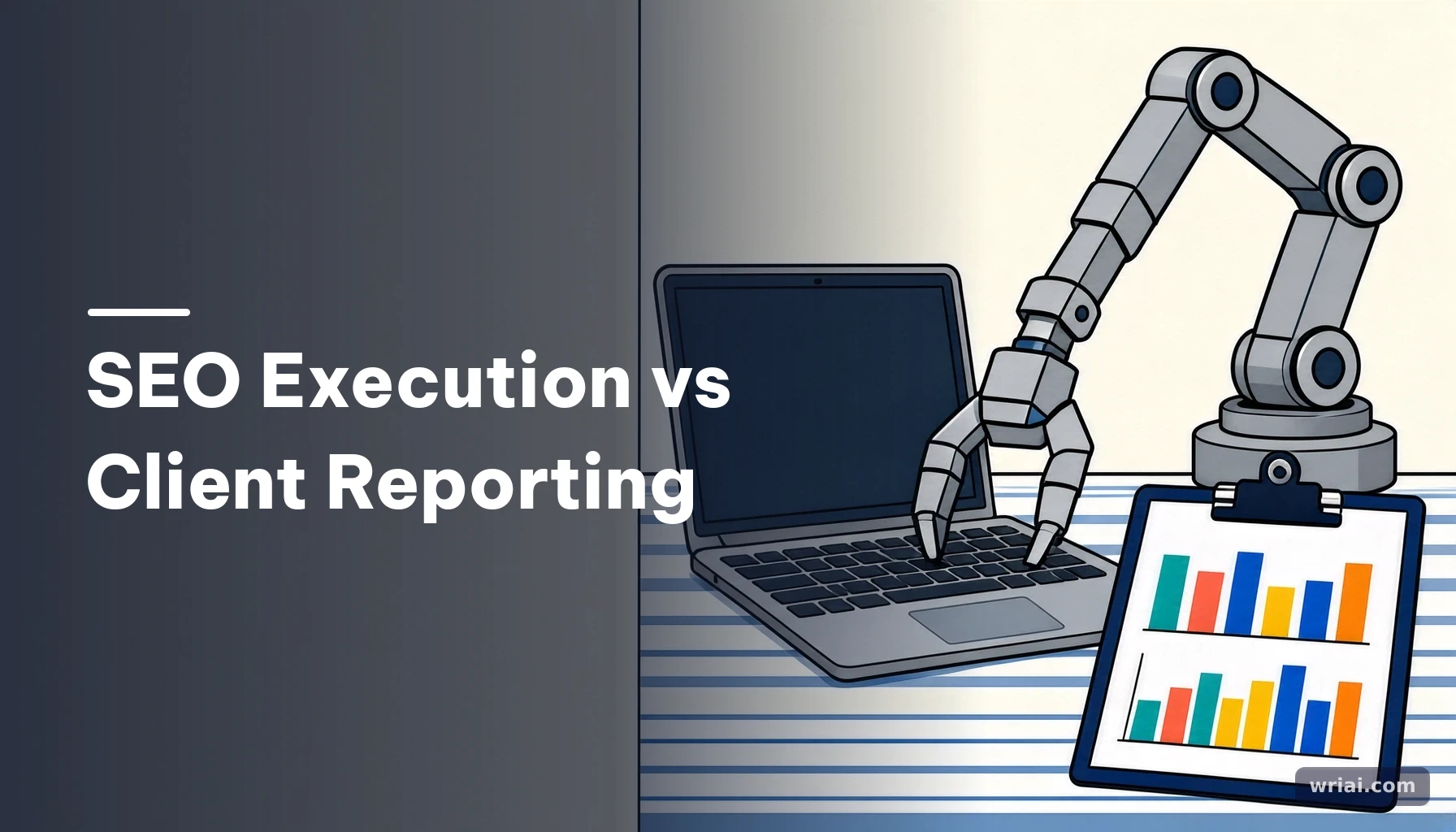
Wriai vs AgencyAnalytics is not a conventional feature-for-feature comparison because the platforms solve different problems. Wriai is an autonomous SEO execution engine that researches opportunities, creates and publishes content, manages links, and monitors content performance. AgencyAnalytics is a reporting and dashboard platform that aggregates marketing data, visualizes results, and helps agencies communicate performance to clients.
What Wriai and AgencyAnalytics Actually Do
The most important distinction is functional rather than technical: one platform performs SEO work, while the other organizes and reports the results. Understanding that difference prevents buyers from comparing unrelated features or selecting a reporting tool when they need execution capacity.
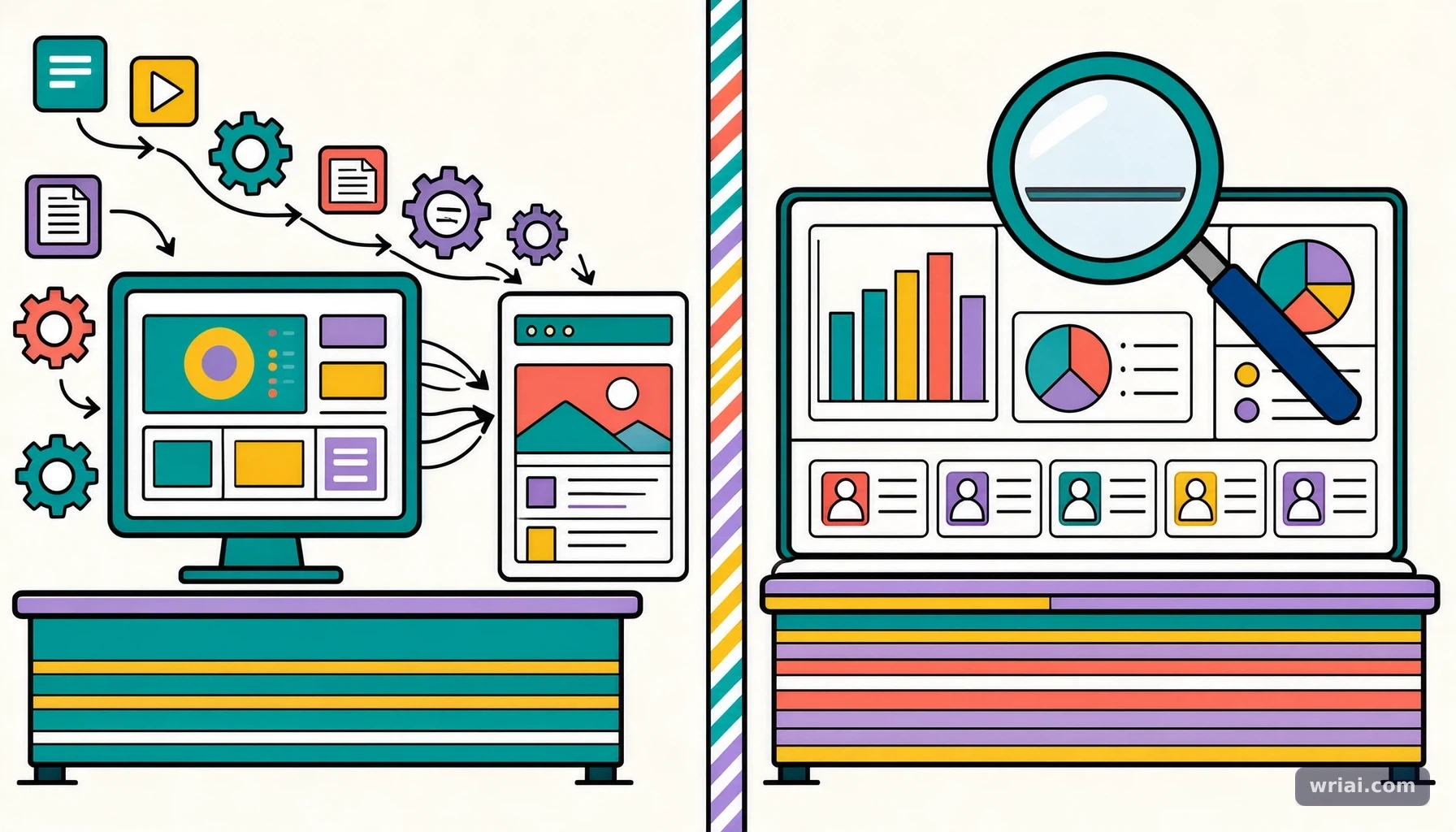 Wriai vs AgencyAnalytics: SEO Automation vs Agency Reporting - Visual comparison of SEO automation tools versus client reporting dashboards
Wriai is built for SEO execution
Wriai is an autonomous AI SEO automation and content lifecycle management platform, combining optimization with automated publishing in a connected workflow. Its purpose is to reduce the manual work involved in moving from an SEO opportunity to a published, connected, indexed, and monitored asset.
Its workflow can include:
- Identifying ranking gaps and high-potential keywords through the Golden Opportunity Engine
- Researching topics and building content clusters
- Creating and optimizing content through the Autonomous E-E-A-T Content Studio
- Publishing or updating content through CMS integrations
- Finding contextual internal and external linking opportunities
- Submitting URLs to search engine indexers
- Distributing published content across connected social channels
- Monitoring performance and identifying content decay
- Refreshing underperforming content when recovery is appropriate
This makes Wriai a doer rather than merely a source of recommendations. It is designed for teams that want an automated workflow covering multiple stages of organic growth, especially when producing and maintaining content at scale would otherwise require several specialists.
AgencyAnalytics is built for reporting and client visibility
AgencyAnalytics is a marketing reporting and dashboarding platform, much like other SEO reporting platforms compared with Wriai. It connects data from multiple sources and presents that information through customizable dashboards, scheduled reports, and client-facing portals.
Its core functions include:
- Aggregating information from more than 80 marketing integrations
- Connecting sources such as Google Search Console, Google Analytics, Google Ads, Facebook Ads, Ahrefs, Semrush, and Google Business Profile
- Creating white-label dashboards with an agency’s branding
- Scheduling automated email and PDF reports
- Giving clients access to performance portals
- Supporting communication between agencies and clients through shared reporting
AgencyAnalytics does not replace the SEO specialist, writer, publisher, or strategist who performs the underlying work. Instead, it replaces or reduces the manual effort involved in collecting metrics, assembling reports, and explaining campaign performance.
Why the distinction matters to buyers
A useful diagnostic question is: What happens after the software finds an opportunity?
With an execution platform, the answer may include research, content production, publishing, linking, indexing, distribution, and monitoring. With a reporting platform, the answer is usually that the opportunity or result appears in a dashboard for someone to interpret and act upon.
This distinction affects staffing, workflows, and success criteria:
- A content team scaling organic visibility needs production and lifecycle automation.
- An agency managing multiple accounts needs consistent reporting and client access.
- An in-house team may need both execution and measurement.
- A strategist who already has writers and developers may value reporting more than automated publishing.
- A small team with limited capacity may prioritize reducing the number of manual SEO steps.
The platforms can therefore be complementary. An agency could use an execution engine to carry out an SEO program and use AgencyAnalytics to show clients what happened afterward.
Wriai vs AgencyAnalytics: A Practical Comparison
The comparison below focuses on operating role, workflow, and use case rather than subscription costs. It is intended to help readers identify which capability is missing from their current process.
| Evaluation area | Wriai | AgencyAnalytics | What the difference means |
|---|---|---|---|
| Primary category | Autonomous AI SEO automation and content lifecycle management | Marketing reporting and dashboarding | They belong to different parts of the marketing stack |
| Main job | Executes SEO tasks across the content lifecycle | Aggregates and presents performance data | One performs work; the other makes work visible |
| Opportunity discovery | Uses search and website data to identify ranking gaps and opportunities | Displays data from connected tools and platforms | Discovery in one is tied to action; reporting in the other supports analysis |
| Content research | Researches topics and develops content clusters | Does not function as a content research or production system | Teams need a separate content workflow when using reporting alone |
| Content creation | Generates and optimizes content through an autonomous content studio | Not a primary capability | AgencyAnalytics reports content outcomes rather than creating content |
| CMS publishing | Supports automated publishing and updating to websites | Not positioned as an automated publishing engine | Publishing remains a separate operational step |
| Internal linking | Identifies and executes contextual linking opportunities | Reports data from connected sources | Linking automation and link-performance reporting are different jobs |
| Indexing workflow | Can submit URLs to indexers as part of a closed-loop process | Provides visibility into connected marketing data | Indexing is an execution activity, not a dashboard function |
| Social distribution | Can distribute published content through connected social channels | Aggregates social performance data | One distributes; the other reports on distribution-related metrics |
| Content maintenance | Monitors for decay and supports content recovery | Shows performance data that may reveal declines | Recovery requires an execution process beyond reporting |
| Client dashboards | Not the central positioning | White-label dashboards, portals, and branded reports | AgencyAnalytics is stronger for client-facing visibility |
| Data aggregation | Uses data to drive automated SEO workflows | Connects more than 80 marketing integrations | Reporting platforms generally offer broader cross-channel consolidation |
| White labeling | Not the defining function | Supports agency branding, domains, dashboards, and reports | Important for agencies selling a reporting experience |
| Typical user | SEO professionals, content marketers, website owners, and SaaS businesses | Agencies, freelancers, and in-house teams proving marketing ROI | The best choice depends on the operational bottleneck |
| Primary output | Published, linked, indexed, distributed, and maintained SEO assets | Dashboards, scheduled reports, and client-accessible metrics | Outputs reflect execution versus communication |
| Best measurement question | What should we create, publish, optimize, or recover next? | What happened, how did performance change, and how do we report it? | The questions are related but not interchangeable |
Which capabilities overlap, and which do not?
There is some conceptual overlap around monitoring. Both workflows can involve performance data, but they use that information differently. An execution platform uses monitoring to decide what should happen next, such as updating content affected by decay. A reporting platform uses monitoring to help a human understand and communicate performance.
The difference is especially important for content operations. A dashboard may show that a page is losing impressions or rankings, but it does not automatically mean the page will be researched, rewritten, republished, internally linked, and submitted for indexing. Those actions require an execution layer.
Similarly, an automated publishing workflow does not automatically provide a polished client portal. Agencies that need branded reporting may still require a dedicated reporting system even when content production and SEO operations are automated.
How should teams evaluate the two categories?
Evaluate the platforms against the constraint causing the most damage:
- Too few opportunities identified: prioritize opportunity research and search-data analysis.
- Too much time spent writing and publishing: prioritize content and workflow automation.
- Inconsistent internal linking or updates: prioritize lifecycle management.
- Manual monthly reporting: prioritize data aggregation and report scheduling.
- Clients cannot see results clearly: prioritize white-label dashboards and portals.
- No one knows what to do with declining pages: prioritize decay detection and recovery workflows.
This approach is more reliable than comparing the number of integrations, dashboard widgets, or AI references. A large integration library does not solve a content production bottleneck, and an automated writer does not automatically solve client communication.
How to Use Each Platform in a Real SEO Workflow
The right implementation depends on whether the immediate goal is to execute organic growth activities, report their results, or connect both processes into a closed operational loop.
Step 1: Identify the missing stage in the workflow
Map the current process from discovery to reporting:
- Search and competitor research
- Opportunity selection
- Brief and content development
- Editing and quality control
- CMS publishing
- Internal and external linking
- Indexing submission
- Social distribution
- Performance monitoring
- Content updates and recovery
- Client or stakeholder reporting
If the bottleneck is concentrated in steps 1–10, an execution-focused platform may provide the greatest operational benefit. If the work is already being completed but steps 9–11 are fragmented, a reporting platform may be more relevant.
This mapping also exposes false automation. For example, generating a draft is not the same as publishing it, linking it, indexing it, monitoring it, and updating it after performance changes.
Step 2: Create a closed-loop execution process
For teams using Wriai as part of their SEO operations, the logical sequence is:
- Discover: analyze search and website data for ranking gaps.
- Prioritize: select opportunities based on relevance and realistic potential.
- Research: develop the topic, supporting entities, and content-cluster relationship.
- Create: produce content aligned with search intent and E-E-A-T principles.
- Publish: move the approved asset into the connected CMS.
- Connect: add contextual internal and external links.
- Index: submit the URL through available indexing workflows.
- Distribute: share the asset through connected social channels.
- Monitor: observe visibility and performance signals.
- Recover: identify decay and refresh content when evidence supports an update.
The value of this sequence is continuity. Each stage creates information for the next stage, reducing the risk that research, production, publishing, and maintenance become isolated activities.
Alex Vance’s experience across algorithmic SEO and semantic knowledge systems supports a practical principle here: automation is most useful when it preserves context between stages. A keyword list, article draft, publication date, linking structure, and later performance signal should be treated as connected parts of one lifecycle rather than separate spreadsheets.
Step 3: Use reporting to explain outcomes
For an agency or stakeholder-facing team, the reporting process begins with data-source selection. Connect the relevant search, analytics, advertising, social, local, and third-party SEO sources, then design dashboards around decisions rather than around every available metric.
A useful reporting workflow is:
- Connect the required marketing sources.
- Group metrics by business or campaign objective.
- Configure dashboard widgets for visibility, traffic, conversions, and channel performance.
- Apply branding and client-access permissions.
- Schedule recurring reports.
- Add written interpretation where a metric requires context.
- Compare the reported result with the actions taken during the period.
AgencyAnalytics is particularly relevant at this stage because its white-label dashboards, client portals, and automated reports are designed to make performance accessible to external stakeholders. The report should answer what changed, why it changed, what was done, and what should happen next.
Step 4: Connect execution and reporting without confusing their roles
Using both categories can produce a stronger operating model:
- The execution layer identifies opportunities and carries out SEO tasks.
- The reporting layer consolidates performance data across channels.
- The SEO team reviews whether automated actions produced useful outcomes.
- The account team translates those outcomes into client-ready explanations.
- The next execution cycle uses the findings from monitoring and reporting.
The connection should be deliberate. Reporting should not be treated as proof that every automated task was valuable, and automation should not be judged only by the appearance of completed tasks. The meaningful test is whether the workflow creates relevant assets, maintains them appropriately, and improves the quality of decisions.
Common Mistakes and Expert-Level Evaluation Tips
Most poor comparisons arise from treating reporting, recommendations, and execution as interchangeable. They are different capabilities with different risks, controls, and measures of success.
Mistake 1: Comparing features without comparing jobs
A dashboard widget and a content-publishing workflow are not competing versions of the same feature. One helps a person inspect information; the other changes the website or content system.
Instead of asking which platform has more features, ask:
- Does the platform create an action or merely display a signal?
- Does it operate inside the CMS?
- Does it preserve context from research to publication?
- Does it support ongoing maintenance?
- Does it help an agency communicate results externally?
This job-based comparison produces a more accurate shortlist.
Mistake 2: Treating AI content generation as full SEO automation
An AI writer may produce text, but full SEO automation requires more than drafting. Research, content-cluster planning, CMS publication, linking, indexing, distribution, monitoring, and decay recovery all affect the lifecycle of an organic asset.
A practical test is to trace one article from keyword discovery to its first update. If several unconnected tools, exports, approvals, and manual uploads are required, the process is not end-to-end automation even if one stage uses AI.
Quality control also remains important. Automated workflows should operate within clear editorial standards, especially for sensitive topics, brand claims, factual accuracy, and pages where expertise and trust are material to the reader.
Mistake 3: Using reporting metrics as a substitute for strategy
A polished report can show impressions, clicks, rankings, traffic, advertising performance, and social results without explaining whether the underlying strategy is sound. Metrics describe outcomes; they do not automatically determine the next action.
For example, a decline in organic clicks may result from content decay, changing search demand, competition, technical problems, or a shift in search-result presentation. A reporting platform can help expose the change, but interpretation and remediation require an SEO process.
Real-world example: a SaaS content team
Suppose a SaaS company has a small marketing team and a large topic universe. Its main constraint is not explaining results to clients; it is finding worthwhile opportunities, producing content consistently, publishing it, and maintaining older pages.
An execution-focused workflow is more closely aligned with that constraint. The team can still use analytics and search data for governance, but the primary value comes from reducing the operational gap between opportunity discovery and a maintained website asset.
Real-world example: a multi-client agency
Now consider an agency with writers, strategists, developers, and established publishing processes. Its recurring problem is assembling data from multiple platforms, creating consistent branded reports, and giving clients access to understandable dashboards.
Here, AgencyAnalytics addresses the central problem more directly. It can consolidate information from connected marketing tools and support client communication without attempting to replace the agency’s existing SEO execution team.
Real-world example: an agency that needs both
A larger agency may execute content and technical SEO through one operational system while using AgencyAnalytics for cross-channel reporting. This arrangement is logical when the agency needs both production capacity and a professional client-facing measurement layer.
The key governance question is ownership. Someone should define which system is authoritative for tasks, which is authoritative for performance reporting, and how discrepancies are investigated. Without that agreement, teams may mistake incomplete data synchronization for a change in SEO performance.
Which Platform Fits Your Situation?
The better choice depends on whether your primary need is to produce and maintain organic-search assets or to demonstrate the performance of work already being done. Neither category is automatically superior for every team.
Choose an execution-focused platform when output is the bottleneck
An autonomous SEO workflow is more relevant when you need to:
- Find ranking opportunities systematically
- Build content clusters rather than isolated articles
- Produce and update substantial content volumes
- Publish directly to connected websites
- Automate contextual linking
- Support indexing and social distribution
- Detect content decay and trigger recovery work
- Reduce repetitive coordination between SEO, content, and publishing tasks
This is especially applicable to SEO professionals, content marketers, website owners, and SaaS businesses that have organic growth opportunities but limited operational capacity.
The evaluation should focus on workflow completeness, data inputs, editorial controls, CMS compatibility, and how clearly the system records what it did. A platform that completes more connected stages may reduce more manual work than one that performs a single stage exceptionally well.
Choose a reporting platform when accountability is the bottleneck
A reporting and dashboarding platform is more relevant when you need to:
- Combine SEO, PPC, social, local, and analytics data
- Create branded client dashboards
- Provide portal access to multiple clients
- Schedule recurring PDF or email reports
- Reduce manual spreadsheet collection
- Standardize how account teams communicate performance
- Give stakeholders a real-time view of marketing metrics
This is particularly suitable for agencies, freelancers, and in-house teams that already have execution processes but need clearer measurement and communication.
Before adopting a reporting system, define the decisions each dashboard should support. A dashboard with every available metric may look comprehensive but can make it harder for a client or executive to identify the important change.
Use both when execution and reporting are separate needs
The two tools can coexist because they occupy different layers:
- Execution layer: discovers, creates, publishes, links, indexes, distributes, monitors, and recovers.
- Measurement layer: aggregates, visualizes, brands, schedules, and communicates.
- Human governance layer: approves priorities, checks quality, interprets results, and adjusts strategy.
For readers comparing AI SEO systems with established reporting tools, the most important conclusion is simple: do not select a reporter when you need a doer, and do not select an execution engine when your principal requirement is a client-ready reporting environment.
A useful final test is to write the first operational question your team asks each morning. If it is “What should we create, publish, or recover next?”, prioritize execution. If it is “How did each client or channel perform, and how do we show it?”, prioritize reporting. If both questions are equally urgent, an integrated stack may be more appropriate than forcing one platform to perform both jobs.
FAQ
Is Wriai a replacement for AgencyAnalytics?
No. The platforms serve different primary purposes. Wriai is designed to automate SEO execution across research, content creation, publishing, linking, indexing, distribution, monitoring, and content recovery. AgencyAnalytics is designed to aggregate marketing data into dashboards, reports, and client portals. An agency may use an execution platform to carry out SEO work and AgencyAnalytics to communicate the resulting performance to clients and stakeholders.
Which platform is better for content production?
An execution-focused platform is the more relevant category for content production because it can support opportunity discovery, research, content-cluster development, creation, CMS publishing, linking, and ongoing updates. AgencyAnalytics is not primarily a content-production system. It can help teams report on performance after content is published, but it does not replace the research, writing, editing, publishing, and maintenance workflow required to operate a content program.
Which platform is better for marketing agencies?
The answer depends on the agency’s main bottleneck. AgencyAnalytics is better aligned with agencies that need white-label dashboards, client portals, multi-source data aggregation, and scheduled reports. An autonomous SEO platform is better aligned with agencies that need to increase content output and automate repetitive SEO execution. Agencies with both operational and reporting needs may use the categories together rather than treating them as mutually exclusive alternatives.
Can reporting data improve an automated SEO workflow?
Yes, when the data is interpreted and connected to an action. Performance monitoring can reveal ranking gaps, declining pages, changes in visibility, or campaigns requiring further investigation. An execution workflow can then prioritize research, content updates, linking, or recovery. However, a dashboard alone does not automatically diagnose every cause or perform every remediation. Teams still need defined decision rules, quality controls, and human oversight for important strategic and editorial choices.
Alex Vance
Head of AI SEO & Autonomous Growth Systems
Specialist with 9+ years of experience in algorithmic search engine optimization, semantic knowledge graphs, and large-scale LLM automation.