IndexNow API vs Google Indexing API: Which Is Faster in 2026?
IndexNow API vs Google Indexing API is not a simple race between two equivalent submission tools: IndexNow can notify multiple participating search engines about URL changes, while Google’s Indexing API sends notices only to Google and has a narrower official scope. Neither API guarantees indexing or a fixed time-to-index. The right choice depends on which search engines matter, what content you publish, and how you verify the result.
How the two indexing approaches work
IndexNow and Google’s Indexing API serve different ecosystems. IndexNow is a shared notification protocol; Google’s API is a Google-specific route for submitting certain URL updates, alongside Google’s normal crawling and indexing systems.
 IndexNow API vs Google Indexing API: Which Is Faster in 2026? - How the two indexing approaches work
IndexNow: notify participating search engines
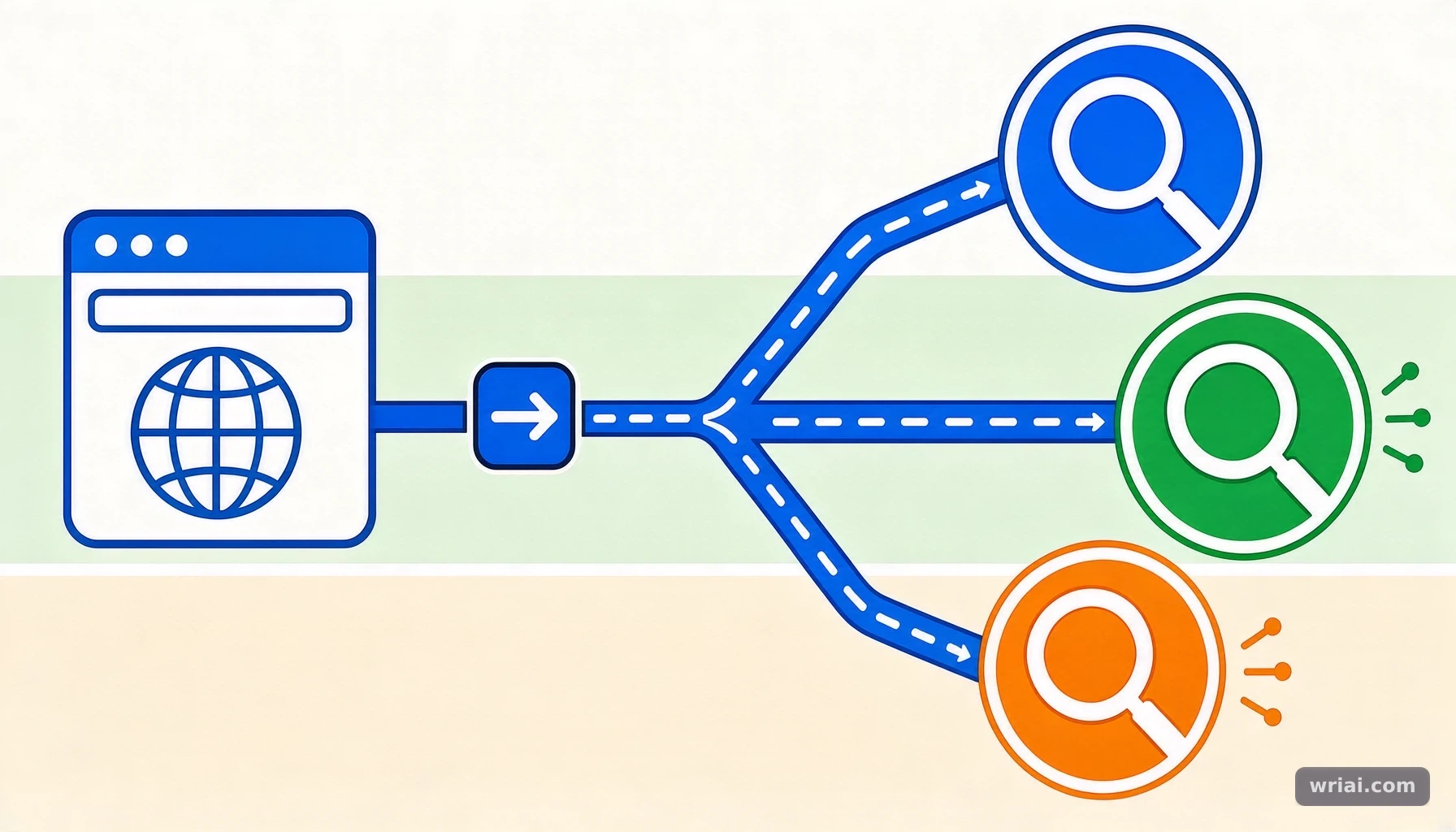
IndexNow is an open protocol supported by participating search engines, including Microsoft Bing and Yandex. When a page is created, updated, or deleted, a website can send its URL to an IndexNow endpoint. The notification can then be shared with participating engines, rather than requiring a separate submission call for each one.
This is a push notification, not an instruction to index a page. It tells search engines that a URL has changed and may be worth crawling. The engine decides whether and when to crawl, and whether the page belongs in its index. A successful request therefore confirms notification—not inclusion in search results.
The basic site verification process is comparatively simple: generate a key, host its text file at the required location on the website, and submit URLs with the key. IndexNow is designed for frequent updates and does not impose the same kind of strict daily quota hurdles described for Google’s API.
Google’s Indexing API: a limited Google-only submission path
Google’s Indexing API is proprietary and operates within Google’s search ecosystem. Its official intended scope is primarily pages that contain JobPosting or BroadcastEvent structured data. It is not a general-purpose API officially intended to submit every article or product page for indexing.
Webmasters have used it for other page types, but that use should not be confused with Google’s stated scope or interpreted as a guarantee of faster indexing. Google still determines whether and when to crawl and index a URL.
Setup involves a Google Cloud project, a service account, OAuth 2.0 authentication, and appropriate credential handling. The API also has quotas; higher limits may be requested, but quota availability and processing do not guarantee that a page will be indexed.
Push notification is not the same as crawling
The useful distinction is between notifying a search engine and having it crawl and index a URL. IndexNow can quickly distribute a change notification to participating engines. Google’s API can send a supported notification to Google. Neither action bypasses crawl decisions, quality assessment, canonicalization, access controls, or other indexing systems.
Claims such as “Bing indexes in minutes” or “Google indexes in 6–24 hours” should not be treated as dependable benchmarks. Time varies by URL, site, content, and search engine, and the available facts do not establish a universal timing comparison. Measure outcomes on your own site rather than promising a fixed window.
IndexNow API vs Google Indexing API: key differences
The practical comparison is reach, eligibility, setup, and operational limits—not a guaranteed speed ranking. Use the table to select a submission path that matches the content and search engines you need to reach.
 IndexNow API vs Google Indexing API: Which Is Faster in 2026? - IndexNow API vs Google Indexing API: key differences
Side-by-side comparison
| Comparison point | IndexNow | Google Indexing API |
|---|---|---|
| Operator and model | Open protocol supported by participating search engines | Proprietary Google API |
| Search engine reach | One submission can notify participating engines, including Bing and Yandex | Google Search only |
| Intended content | URLs of varied content types can be submitted | Officially focused mainly on JobPosting and BroadcastEvent pages |
| Notification type | Push notification when content is created, updated, or deleted | Google-specific URL update notification |
| Basic verification | Host a generated key file on the website | Configure Google Cloud access and service-account authentication |
| Authentication | Key-based site verification | OAuth 2.0 through a service account |
| Quotas and frequency | Built for frequent updates; no strict daily quota limits for standard publishing frequencies are specified here | Daily quotas apply; higher limits may be requested |
| What a successful request means | The URL change was reported through the protocol | The request was accepted by Google’s API |
| What it does not guarantee | A crawl, index inclusion, or ranking | A crawl, index inclusion, or ranking |
| Useful operational role | Broad notification across participating engines | A Google-specific path for eligible URL types |
Which one is faster?
There is no reliable universal answer. A URL submitted through IndexNow may be crawled quickly by a participating engine, but that outcome depends on the engine and the site. A Google API request may be accepted without the URL appearing in Google Search immediately—or at all.
Treat “minutes” and “6–24 hours” as anecdotal observations unless they come from a clearly defined, repeatable test on comparable URLs. A useful test records when a page was published, when each API request succeeded, when the search engine first crawled it, and when it became discoverable in the index. Keep those events separate: submission time is not crawl time, and crawl time is not index time.
How to choose by content and coverage
Choose IndexNow when you publish frequent changes and want to notify participating search engines through one protocol. It is suitable for a wide range of URL types, subject to the protocol’s requirements and each engine’s own decisions.
Consider Google’s Indexing API for its official use cases, especially eligible job and livestream pages. For ordinary content, do not rely on it as a substitute for sound technical SEO or Google’s normal crawling process. If your goal is cross-engine coverage, IndexNow and Google’s separate systems can serve complementary roles rather than competing for a single winner.
How to set up URL notifications
A reliable implementation starts with accurate URL-change events, secure credentials, and clear logging. Submit only URLs that genuinely changed, and verify outcomes independently instead of treating a successful API response as proof of indexing.
Generate and host an IndexNow key
Create a key for the site and place the corresponding text file in the website root so participating engines can verify that you control the URLs being submitted. The filename and file contents must match the key used in requests. Follow the current IndexNow protocol documentation for exact endpoint and verification requirements; do not assume that one endpoint or parameter format is universal across all implementations.
A basic publishing workflow is:
- Generate and store the key securely in your deployment or CMS configuration.
- Publish the key file at the required site location and confirm that it is publicly accessible.
- When a URL is created, updated, or deleted, add its canonical URL to a submission queue.
- Send the URL and key to an IndexNow endpoint using the supported request format.
- Log the response, timestamp, URL, and event type for troubleshooting.
Avoid submitting staging URLs, redirect chains, private pages, or batches containing malformed URLs. The notification is most useful when the URL resolves correctly and the page is intended to be crawled.
Send IndexNow requests from Python or a webhook
A publishing system can trigger an HTTP request after a confirmed content change. The following is an illustrative Python pattern; replace the endpoint and request parameters with those required by the current IndexNow implementation you use.
import requests

endpoint = "https://api.indexnow.org/indexnow"
payload = {
    "host": "example.com",
    "key": "YOUR_INDEXNOW_KEY",
    "keyLocation": "https://example.com/YOUR_INDEXNOW_KEY.txt",
    "urlList": ["https://example.com/new-page/"]
}

response = requests.post(endpoint, json=payload, timeout=10)
response.raise_for_status()
print(response.status_code)
In production, keep the key out of source control, handle network failures with bounded retries, and respect the endpoint’s accepted request format and batch constraints. A webhook from a CMS can pass the changed URL to a small service that validates the domain, deduplicates repeat events, and submits the notification. Retries should not create an uncontrolled loop when the endpoint is unavailable.
Add Google’s API only where appropriate
For Google’s API, configure a Google Cloud project and service account, enable the relevant API, and grant the service account the required access in the applicable Google property. Use OAuth 2.0 credentials and protect the JSON key as a secret; do not commit it to a public repository or expose it in browser-side code.
Build the integration as a separate adapter from IndexNow. That makes it possible to apply Google-specific eligibility rules and authentication without complicating the multi-engine notification path. The wider publishing workflow can trigger both adapters after publication, but the Google call should not be represented as an official general-purpose submission route for every content type.
Build a dependable multi-engine publishing workflow
A strong workflow uses each API for the job it actually supports: IndexNow for participating engines and Google’s API for its limited intended scope. Publishing should trigger notifications automatically, while monitoring distinguishes API acceptance from crawling and indexing.
Trigger notifications when a page is ready
The best trigger is a successful publication or update event—not merely the creation of a draft. Before submitting, confirm that the page is publicly accessible, returns the expected status, has a stable canonical URL, and is not blocked from crawling. Then route the URL to the appropriate notification systems.
For broad non-Google coverage, send the URL through IndexNow. In parallel, submit to Google’s Indexing API only when the page fits its official scope and the account configuration is valid. This parallel design avoids treating Google as part of IndexNow’s broadcast and avoids assuming IndexNow sends notifications to Google.
A CMS integration can make the timing consistent. For example, a CMS auto-publishing pipeline can be paired with a post-publication event that queues indexing notifications, rather than requiring an editor to submit URLs manually.
Verify the result, not just the request
Maintain separate records for published, submitted, crawled, and indexed states. API responses help diagnose submission failures, but they do not establish that a search engine has indexed a page. Use the relevant search engine’s tools and reporting to check discovery and indexing, and allow for processing variation.
For Google, verify whether the URL is indexed rather than assuming that an accepted request caused inclusion. A tool such as Wriai’s instant Google Index Checker can be one option for checking index status; confirm important URLs through Google’s own reporting tools as well.
A useful monitoring record includes the canonical URL, change type, submission timestamp, response status, subsequent crawl evidence, and index-status check. This makes it possible to identify patterns—for example, whether updated pages are being crawled but not indexed—without confusing a notification problem with a content or technical issue.
Where automation platforms fit
At scale, manual submission becomes error-prone: updates can be missed, URLs can be duplicated, and credentials can be mishandled. An automation platform can connect publication events with submission, logging, and follow-up checks. Wriai includes search-engine indexing as part of a broader SEO workflow; the key operational principle is to trigger notifications from verified publishing events and keep the resulting status observable.
Automation does not make indexing automatic in the literal sense. It reduces the delay between a site change and a notification, while search engines retain control over crawling and index inclusion. That distinction matters when setting expectations with clients or reporting on the results of a content launch.
Common mistakes and advice by use case
The best setup depends on your content types, publishing frequency, search-engine priorities, and technical capacity. Most sites benefit more from correct URL handling and useful content than from adding more submission calls.
Mistakes that undermine submissions
- Promising a fixed indexing time: Neither API guarantees indexing within minutes or a set number of hours.
- Using Google’s API as a universal URL submitter: Its official scope is limited, especially compared with the variety of URLs accepted by IndexNow.
- Treating a successful response as index inclusion: Acceptance means the notification was received, not that the page is in search results.
- Submitting the wrong URL: Redirected, non-canonical, blocked, or staging URLs can make a notification less useful.
- Ignoring key and credential security: Keep IndexNow keys and Google service-account credentials out of public code and client-side applications.
- Sending every URL repeatedly without event control: Deduplicate submissions and trigger them on real changes to avoid noisy, difficult-to-debug workflows.
Recommendations for different sites
A small site with occasional updates can implement IndexNow with a key file and a simple post-publish notification. Focus first on correct canonicals, crawl accessibility, and a useful sitemap. Adding complex API infrastructure is unlikely to help if the underlying pages are inaccessible or low value.
A publisher or ecommerce site with frequent changes can benefit from an event-driven IndexNow queue for new, updated, and deleted URLs. Use validation and logging to prevent duplicate events and make failed submissions visible. For Google, continue to use the normal technical SEO and reporting processes, and reserve the Indexing API for appropriate content.
A site publishing eligible job or livestream pages can evaluate Google’s API alongside IndexNow. Keep each route independent: a URL may qualify for the Google API and also be notified through IndexNow for participating engines. Eligibility should be checked per page type, not inferred from the fact that an API call can be made.
For teams comparing implementation options, this guide to Google Indexing API tools can provide additional context. Whatever the tooling, judge performance by observed crawling and index coverage—not by the speed of the HTTP response.
FAQ
These answers clarify what the APIs can do and where common assumptions go wrong. The central point is that submission improves notification, not certainty of indexing.
Does IndexNow submit URLs to Google?
No. IndexNow notifies participating search engines, including Bing and Yandex, but it does not submit URLs to Google through Google’s Indexing API. Google operates its own systems. If you need to notify Google through its API, that is a separate integration with its own authentication, quotas, and limited official content scope. Neither route guarantees that Google—or any other engine—will crawl or index the submitted URL.
Is Google’s Indexing API officially for every page type?
No. Google’s stated intended use is primarily pages with JobPosting or BroadcastEvent structured data. Although some webmasters have used the API for other content, that practice should not be described as Google’s general recommendation or as a guaranteed shortcut. For typical articles, product pages, and other URLs, prioritize crawlable site architecture, accurate canonical tags, useful content, and Google’s normal indexing processes.
How quickly will a URL be indexed after submission?
There is no guaranteed time. A submission may be processed quickly, but the search engine decides whether and when to crawl the URL and include it in its index. Claims of indexing in minutes or within a fixed number of hours are not dependable across sites and page types. Track submission, crawl evidence, and index status separately, and compare results across similar URLs on your own site.
Should I use IndexNow and Google’s API together?
You can use both when each serves a suitable purpose. IndexNow provides a notification path to participating engines; Google’s API is a separate Google-only route with a limited official scope. A publishing workflow can trigger IndexNow for broad participating-engine coverage and call Google’s API for eligible pages. Keep credentials secure, validate URLs before submission, log responses, and verify indexing independently.
Alex Vance
Head of AI SEO & Autonomous Growth Systems
Specialist with 9+ years of experience in algorithmic search engine optimization, semantic knowledge graphs, and large-scale LLM automation.